
Your inbox is probably already full of the pitch for AI. What’s harder to find is a description of the work itself: what an AI program inside a middle market portfolio actually looks like, where it stalls, how the economics are measured, and what an owner can credibly claim to know about this early in the technology’s evolution.
This piece is an attempt to look behind the door at how we think about AI as a value creation lever, what we are doing across our portfolio, and what we are deliberately not yet claiming. What we do know is that anyone claiming they have AI fully figured out right now is likely selling you something.
Taking a Step Back
Sixty percent of private equity GPs say higher debt capital costs (and a lack of multiple expansion) are
forcing a deeper focus on portfolio company operating performance. Operational improvement now ranks as the top value creation lever, cited by 72% of GPs(i) interviewed.
AI is one of the newest operational levers and, despite the market hype, is often the least understood.
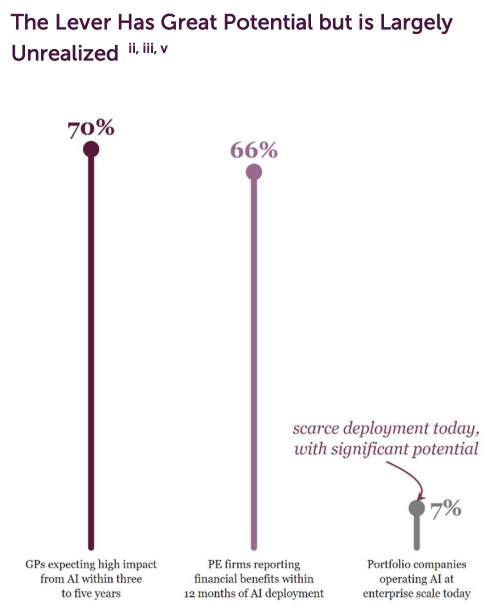
McKinsey’s survey of the GP community captures exactly that: only 7% of GPs report AI delivering high
impact in their operations and investment processes today, yet 70% expect high impact within three to five years. (ii)
The same research notes that leading sponsors now underwrite near-term, executable AI use cases rather than long-dated options, and that assets able to demonstrate tangible AI-driven operating improvement command greater confidence at exit, while those that cannot face sharper scrutiny. AI is becoming a value creation lever during the hold and a multiple consideration at the end of it. For an investor whose exits depend on selling operationally transformed companies, that scrutiny is welcome, provided the transformation is real and measurable.
The Adoption/Value Gap
There is a paradox underneath the headlines visible even inside private equity portfolios, likely the most
motivated corner. Only 36% of portfolio companies are using AI across multiple use cases, and just 7% operate it at enterprise scale. Yet where deployment has happened against a scoped business case, 95% of funds report initiatives meeting or exceeding that case. (iii)
There have been a wave of headlines from CFOs who say they are not seeing ROI from AI; the tempting conclusion is that the technology is overhyped and the spending has gotten ahead of the substance. But that doesn't square with what is actually happening at the initiative level. Projects that get scoped properly (a defined problem, a real owner, a clear metric to tackle, targeted change management, the appropriate tech) are often meeting or exceeding their business case. The real gap is that very few companies run AI strategically. What stops them is execution: they start with the tech and find a problem to tackle, they aim it at the wrong problem altogether, underinvest relative to what the problem is worth, or measure the wrong outcome. Often, it's several of these at once. Closing that gap starts with being clear-eyed about where a given effort actually sits and what it's built to deliver. We see the spectrum as three levels with varying types of impact described below.
The Three Levels of AI Impact
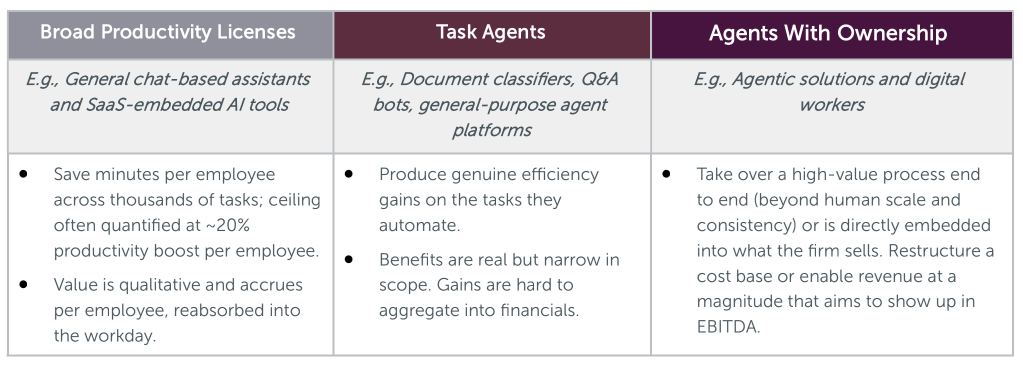
Most corporate AI budgets account for productivity licenses while boards wait for financial results, then conclude “we invested in AI and saw no return.” That is the wrong lesson: the gap is in the organization and its capacity to deploy impactful solutions, which is exactly where an owner can actively and strategically intervene.
Why the Middle Market Is Where the Gap Is Widest and Most Closable
The deployment gap is not evenly distributed, and it is widest in the middle market. Among these enterprises, 57% remain stuck in agentic AI pilots, only 15% have operationalized AI agents across functions, and just 7% have governance policies built for them. iv The causes are familiar to anyone who has operated here: thin data infrastructure, no dedicated AI leadership, and management teams fully consumed running the business. A typical middle market company cannot hire its way into serious AI capability, and the consultancies built to serve the Fortune 500 are not structured to serve it economically.
AI builders have the inverse problem: deployment. The technology itself is commoditizing fast. What
stays scarce is access to real operating environments, proprietary workflows, and decision-makers who can commit. A control-oriented private equity owner sits at that intersection and is positioned to resolve both sides of it across their entire portfolio. There are meaningful advantages to employing this across the entire portfolio at once, that we describe in more detail below.
Three structural features make the middle market unusually responsive to this transformation. First,
financial visibility. In a company with $30-50 million of EBITDA, a single embedded deployment that
compresses a meaningful cost line is visible in the financial statements and, possibly, at a transaction
multiple in enterprise value. The same build inside a Fortune 500 company is a rounding error and
afterthought. Second, decision velocity. Leadership alignment in a founder-led or sponsor-backed
company is achievable in weeks, not committee cycles. This allows for projects to be scoped, planned
and executed toward a specific measurable objective in a compressed cycle. Third, process concentration. Middle market operations run through a relatively small number of workflows, which means the highest-value processes can be identified, scoped, and measured from an AI perspective, leading to meaningful potential impact and value generation.
This thesis sharpens further in the part of the market Axar tackles. Companies emerging from distress or
prolonged operational underinvestment carry years of deferred technology spend: fragmented systems,
manual workarounds, processes held together by institutional memory. Historically, that debt was remediated slowly, through multi-year system implementations bought at enterprise prices. AI is changing the remediation math. Many of the workflows that once required heavy enterprise software can now be addressed directly with AI, and a turnaround is by nature a process-by-process rebuild.
How We Are Approaching It: A Playbook
Strategy before tools: We are actively assessing our portfolio on three dimensions surrounding AI:
leadership alignment, infrastructure readiness, and current capability. Our early finding is that the
constraint is rarely technology. More often, it’s an engaged CEO whose technical team cannot translate
interest into a strategy; capable data leadership without the reach to drive change; a CFO who has
never seen a credible ROI model and stalls investment as a result. So, our first level of support at most
companies is not a build. It’s supporting the adoption of a true strategy: what AI means for the business
model, which commercial opportunities are in play, which operations are genuinely AI-amenable, and
who owns the answer. We are codifying this into a living playbook our leadership teams can use as a resource to filter against hype and use to their roadmap.
Two motions run in parallel: Broad enablement (tools, training, AI fluency) lifts the floor and builds the organizational muscle that everything else depends on, but we do not pretend it moves EBITDA. Embedded purpose-built solutions are the opposite motion: top-down, agentic workflows or digital
workers scoped to a specific high-value process, with the ROI case modeled before the build is approved and the payback period defined up front. In both motions, we are creating preferred vendor partnerships to leverage economies of scale across the portfolio and redeployability (see more below).
Build once, deploy across the portfolio: The real edge of a portfolio is the flywheel; repetition compounds across companies. Reconciliation, scheduling, document processing, demand forecasting, inquiry handling. The same processes recur across companies in unrelated industries, and most of the underlying architecture is portable. A solution proven at one company redeploys at the next for a fraction of the original cost, each deployment sharpening the next. Over time this compounds into something a single company can never build: a library of proven, tested use cases that we can deploy quickly at future portfolio companies.
Measure each investment with the right metric: We are translating every initiative into the same
denominator (annualized dollar impact), and we match the metric to the investment: adoption and fluency metrics for enablement; cost-per-transaction and cycle time for contained automation; EBITDA
impact, hard cost reduction, and attributable revenue for embedded systems.
Build the foundation alongside the capability: Data readiness, governance, spend management, and
change management are built in parallel with every deployment. A recent engineering pilot at one of our portfolio companies compressed what would be months of code development into two weeks. It also demonstrated where an insufficiently governed system has potential to overreach and how fast consumption costs escalate without operator discipline. That experience is being leveraged as the basis of a governance framework within that company. We consider that as much a part of the value creation work as the build itself.
Illustrative Axar Portfolio Examples
At Axar, we are actively looking to employ specific AI programs at our portfolio companies while adhering to our overarching playbook we have outlined in this piece. Below are several examples of AI in action:
- Revol One, our insurance platform, is rebuilding its new business operation around agentic AI. The goal is a new business cycle measured in hours rather than the days or weeks typical of the industry, supported by a fraction of the staffing a legacy carrier requires at the same volume.
- J.G. Wentworth, a consumer finance platform, is building an AI voice assistant trained in handling
complex sales and customer service activity. Voice is the company’s primary channel, and call capacity has historically scaled with headcount. AI breaks that link: it absorbs the routine processes at a volume no human can match, while human agents focus on the subset of higher-value conversations, generating discernible value for the company. - Several of our smaller (<250 employee) portfolio companies have kicked off structured AI upskilling engagements with Axar’s dedicated training/implementation partner. The focus here is practical: teaching executives to apply AI tools to the actual work of their specific roles, tapping into the broad enablement motion and per-employee productivity gains described earlier in this piece.
As these projects mature, and others take off, we look forward to sharing case studies with measured results in a future update.
Early Innings
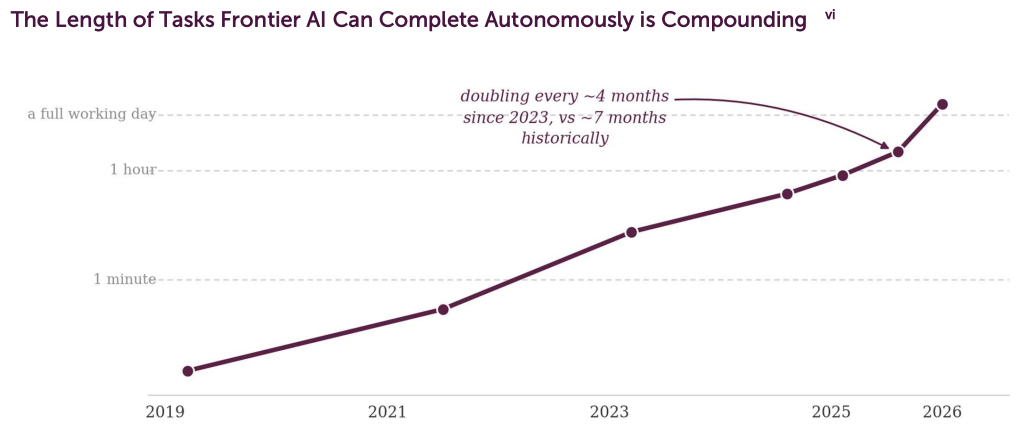
While this piece serves as a playbook for understanding AI’s impact in the middle market and its opportunities, the reality is that the tools and capabilities of AI are rapidly changing. For example, the length of tasks frontier AI systems can complete autonomously has doubled roughly every seven
months for six years, and the most recent estimates put the post-2023 pace closer to every four months, measured at a 50% model success threshold (see chart below). (vi)
Any document written about AI today (including this one) has a short shelf life at the level of specifics. That is why we anchor to a framework rather than a forecast: it tells us what to re-score as the technology moves and which targeted capabilities are relevant to moving the needle at our companies versus merely sounding impressive.
We will likely get many things wrong along the way. However, having a comprehensive strategy around
the AI value gap is a key differentiator in the complex, quickly changing middle market. What compounds through all of it is the habit and a mindset: data discipline, governance built alongside capability, leadership teams that have internalized a way of thinking rather than a list of tools, and a use case library that grows with every deployment. Those assets are not readily available for purchase later, at any price, as they are built through patience and focus on this game-changing technology.

DISCLOSURE
This material is provided for informational purposes only and does not constitute an offer to sell or a solicitation of an offer to buy any securities or investment advisory services. The views expressed herein are those of Axar Capital as of the date of publication and are subject to change without notice.
This material is not intended to provide, and should not be relied upon for, investment, legal, or tax advice. Any forward-looking statements or discussions of potential outcomes are based on current expectations and assumptions and are subject to change. There can be no assurance that any investment strategy will be successful or that any outcomes discussed herein will be achieved. References to specific investments are provided for illustrative purposes only and do not represent all investments made by Axar Capital. Past performance is not indicative of future results.
ENDNOTES:
(i) S&P Global Market Intelligence 2026 Private Equity Survey
(ii) McKinsey Global Private Markets Report 2026 (Private Equity)
(iii) FTI Consulting 2026 Private Equity AI Radar
(iv) Everest Group Agentic AI 2026: A Mid-Market Playbook for Adoption and Scale
(v) FTI Consulting 2026 Private Equity Value Creation Index
(vi) METR Time Horizon 1.1
About Axar Capital Management
Axar Capital Management LP is a $3.3 billion opportunistic investment manager focused on U.S. middle market companies with $200 million to $800 million in debt outstanding. Founded in 2015 and 100% employee-owned, Axar specializes in complex situations where traditional institutional capital operates inefficiently. The firm is headquartered at 402 W 13th Street, New York, NY.
Disclaimer: Axar Capital Management LP ("Axar") has prepared this content for informational purposes only. This content is not intended to constitute legal, tax, financial, or investment advice. While all information contained herein is believed to be accurate, no guarantee, representation or warranty is made as to its accuracy, completeness or fairness. Certain information reflects the current opinions of Axar which may prove to be incorrect and are subject to change. Past performance is not indicative of future results. Investing involves a material risk of loss. Certain statements herein reflect forward-looking views, which are inherently uncertain and subject to change. Actual results may differ materially.
Topics:
.png?width=2400&height=1257&name=73618-%20Axar-%20Blog%20%2310%20-%20derived%20from%20The%20Chopping%20Block%20-%20Feature%20Image%20(1).png)


.png?width=1200&height=628&name=Untitled%20design%20(18).png)








.jpg?width=360&height=203&name=imgi_13_648847-img_bars%20(1).jpg)