
Market participants who approach leveraged loan pricing through a purely fundamental lens will periodically encounter moves that don't make sense. Credits with stable operating performance trade off sharply. Spreads widen without any material change in the underlying business. Bids evaporate in situations where the fundamental case looks constructive.The explanation, more often than not, begins with ownership structure.
CLOs hold over 75% of the leveraged loan market. (Source: JP Morgan) That concentration means the behavioral and structural constraints governing CLO managers are, in aggregate, a primary driver of how this market prices risk, particularly under stress. When overcollateralization test breaches force a regime shift from yield optimization to structural compliance, the selling that follows is not a signal about credit quality. It is a signal about vehicle mechanics. Conflating the two is an analytic error with real cost.
The OC Test Regime Shift
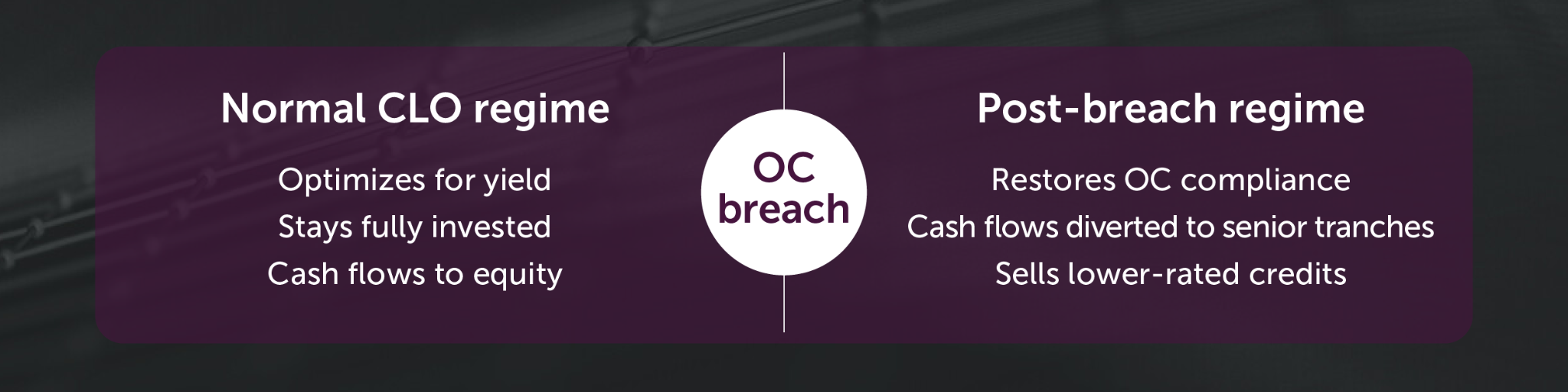
CLO managers operate under a binary incentive structure defined by their overcollateralization tests.
In the pre-breach regime, the calculus is familiar: maximize yield, stay fully invested, manage credit quality within the parameters of the indenture. Retaining exposure to higher-yielding CCC-rated credits is often economically rational when OC cushions are healthy. Cash flows follow the waterfall to equity, and the manager's economics are intact.
Post-breach, the entire calculus inverts. Cash flows are diverted to pay down senior tranches rather than distributed to equity. The manager's immediate priority shifts to restoring OC compliance, which means reducing CCC exposure and improving the portfolio's average credit quality as rapidly as possible. The path of least resistance is selling. Not because the manager has formed a negative view on the credit, but because the structural tests require it.
This is forced selling in the precise sense: selling driven by structural constraint, not by any investment judgment about the underlying company. The distinction matters enormously for buyers attempting to price the resulting supply.
The CCC Transmission Mechanism
The pathway from credit deterioration to OC test failure runs through the CCC bucket, and the dynamics are non-linear in ways that are easy to underestimate.
Standard CLO indentures require that CCC-rated loans be marked to market rather than carried at par in the OC numerator. When a loan is downgraded into CCC, the par-to-market discount flows immediately and directly into the OC cushion calculation. In a deteriorating credit environment, this creates a feedback loop: downgrades expand CCC exposure, CCC marks compress OC cushions, cushion compression accelerates test failures, and test failures trigger the forced selling that puts further pressure on CCC loan prices.
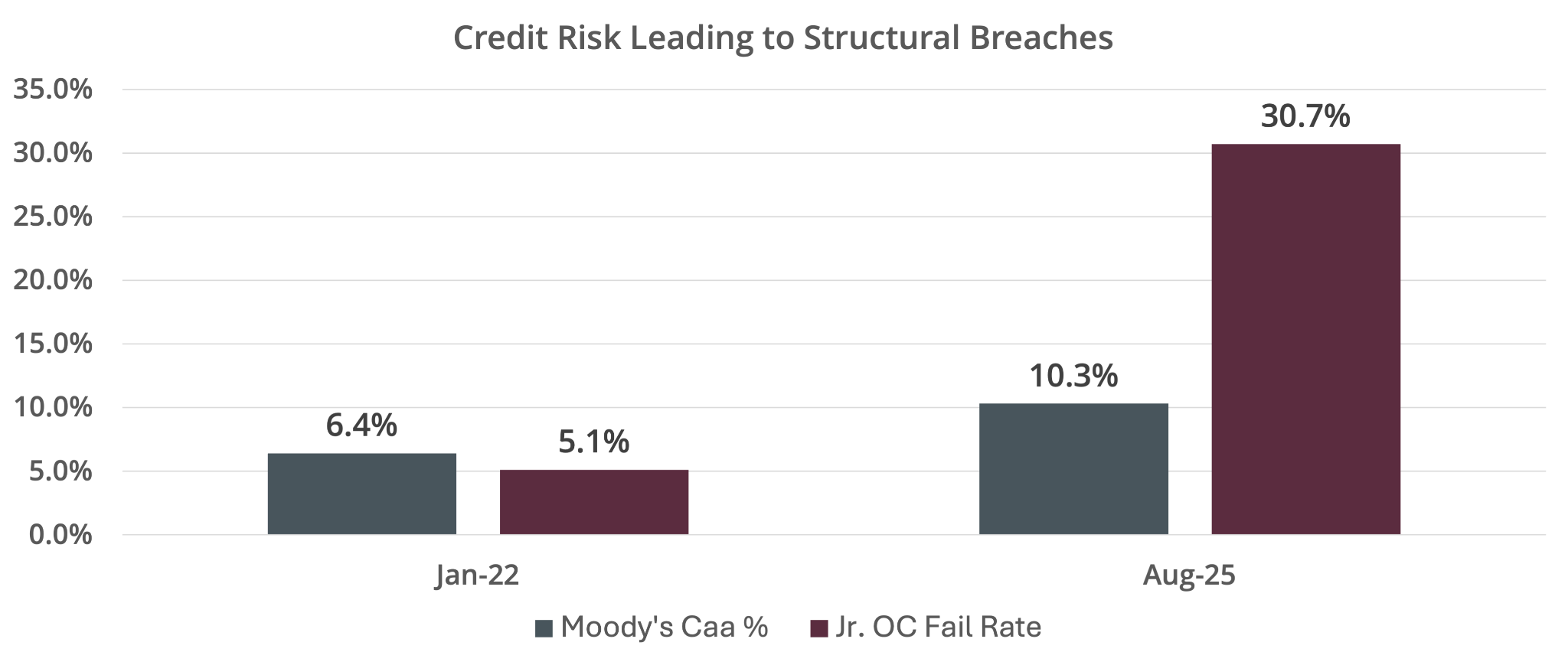
The data from the current cycle illustrates how quickly the mechanism activates. In January 2022, CCC exposure in post-reinvestment-period CLO portfolios stood at 6.4%, with 5.1% of deals failing the junior OC test. By August 2025, CCC exposure had risen to 10.3%, and the junior OC failure rate had reached 30.7%. (Source: BAML) A 4-point increase in CCC concentration produced a six-fold increase in structural failures. The threshold effect, which activates when CCC exposure crosses 7.5%, is the key inflection point: above it, excess CCC exposure is marked to market in full, creating a direct and immediate hit to cushion levels.
Post-Reinvestment-Period Structures Are the Pressure Point
The OC dynamics described above are not uniformly distributed across the CLO universe. Post-reinvestment-period structures are disproportionately vulnerable, and they represent a significant and growing share of the market.
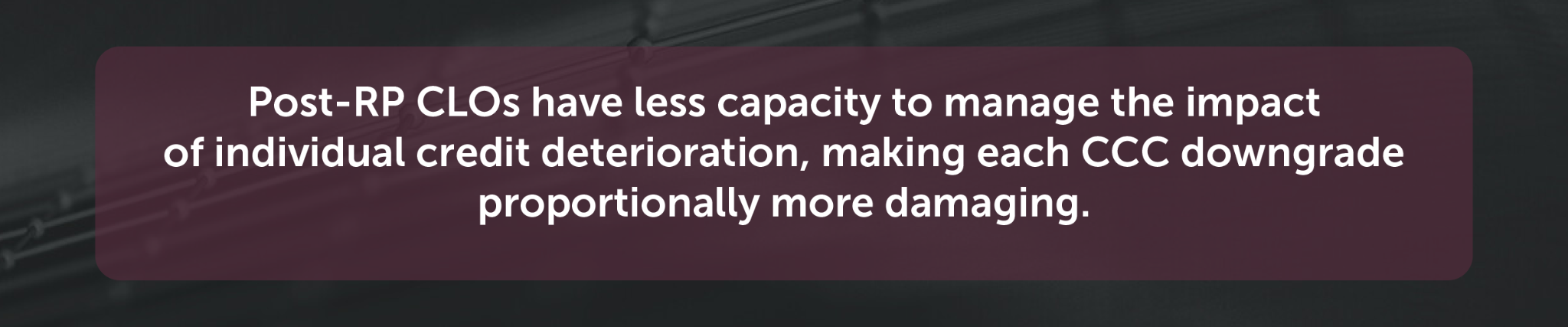
During the reinvestment period, CLO managers retain the flexibility to reinvest principal proceeds into new loans, actively managing portfolio composition in response to credit events. Once the reinvestment period expires, that flexibility disappears. Principal amortizes out of the structure rather than recycling into new assets. The portfolio shrinks, credit quality management becomes reactive rather than proactive, and the proportional impact of any individual downgrade on OC metrics increases as the denominator compresses.
As of September 2025, Axar estimates approximately $200 billion in broadly syndicated loan exposure sits in post-RP CLO structures. (Source: Axar Capital estimate) This segment accounts for a disproportionate share of current OC test failures and the forced selling pressure that accompanies them. With the reinvestment periods of the 2019 to 2021 vintage CLOs continuing to expire, the share of the market operating under these constraints is growing, not shrinking.
The Pricing Implication
The structural dynamic described above generates a specific and recurring type of market inefficiency: supply that appears for reasons unrelated to fundamental credit deterioration, into a bid environment that is thinner than headline default rates or spread levels would suggest.
The buyers who might otherwise provide rational price discovery are, for the most part, unavailable. CLOs in post-breach regimes are net sellers. Mutual funds and ETFs face their own redemption dynamics in volatile environments. The large alternative managers who might previously have stepped in have, as we detailed in our prior piece in this series, largely redirected their focus toward more scalable strategies.
What remains is a market where, at moments of peak structural pressure, price formation may be driven more by who needs to sell than by any disciplined assessment of fundamental value. For investors without those structural constraints, with patient capital, the mandate to underwrite complexity, and the analytical infrastructure to distinguish structural selling from genuine credit deterioration, the resulting dislocations may represent the most consistently mispriced risk in the leveraged loan market.
This dynamic is not a product of the current cycle. The OC test mechanics have been embedded in CLO indentures for decades. What changes is the severity of the credit deterioration that activates them. With downgrades outpacing upgrades in 36 of the last 37 months (Source: Moody's, LCD) and over $400 billion in loans maturing through 2028 (Source: LCD), the conditions that keep this mechanism in motion appear durable.

For the full analysis of how CLO dynamics interact with sponsor-driven LME activity and the competitive retreat from middle market distressed, download Credit Unbound at axarcapital.com.

About Axar Capital Management
Axar Capital Management LP is a $3.3 billion opportunistic investment manager focused on U.S. middle market companies with $200 million to $800 million in debt outstanding. Founded in 2015 and 100% employee-owned, Axar specializes in complex situations where traditional institutional capital operates inefficiently. The firm is headquartered at 402 W 13th Street, New York, NY.
Disclaimer: Axar Capital Management LP ("Axar") has prepared this content for informational purposes only. This content is not intended to constitute legal, tax, financial, or investment advice. While all information contained herein is believed to be accurate, no guarantee, representation or warranty is made as to its accuracy, completeness or fairness. Certain information reflects the current opinions of Axar which may prove to be incorrect and are subject to change. Past performance is not indicative of future results. Investing involves a material risk of loss. Certain statements herein reflect forward-looking views, which are inherently uncertain and subject to change. Actual results may differ materially.
Topics:
.png?width=2400&height=1257&name=73618-%20Axar-%20Blog%20%2310%20-%20derived%20from%20The%20Chopping%20Block%20-%20Feature%20Image%20(1).png)



.png?width=1200&height=628&name=Untitled%20design%20(18).png)







.jpg?width=360&height=203&name=imgi_13_648847-img_bars%20(1).jpg)