
WHAT WE’RE THINKING ABOUT
The Financial Times recently ran a story titled “Distressed debt funds excited about private credit bargains.” The same week, Bloomberg reported that investors tried to pull $5.4 billion from Blue Owl Capital’s two flagship BDCs in a single quarter including 22% of its $36 billion flagship Credit Income fund. Blackstone, Ares, Apollo, Cliffwater, and HPS/BlackRock have all reported record redemptions in their retail-focused private credit vehicles. The financial press was asking whether this is “the canary in a coal mine moment” for the $1.8 trillion direct lending market.
We have argued since 2023 that this credit cycle would be longer and slower than prior ones: a grind, not a crash. The first phase was private equity sponsors’ response to a higher-rate environment, which unleashed a record wave of liability management exercises in 2024 and 2025 across the traded loan and bond markets. We are now entering the second phase, with market anxiety shifting to the ultimate earnings power of issuers supporting today’s debt loads and producing clearer signs of strain, including a growing cohort of debt trading at distressed prices, a steep reversal of flows in direct lending, and existing portfolios being brought to market to meet investor redemptions. We anticipate the third phase to be marked by credit rating downgrades and a spike in defaults over the next couple of years.
We do not yet know how severe this default cycle will be. What we can see, however, is a meaningful distressed opportunity set emerging. Rather than trying to predict what comes next, we thought it useful to look back at what has worked in distressed investing across five decades of corporate credit cycles.
One place to start is a New York City taxi, spring of 1984. A 35-year-old French entrepreneur asked the driver whether he recognized the name of the French president. The driver shook his head, no. Then he asked about Christian Dior. The driver’s eyes lit up.
Bernard Arnault had his answer. Dior’s parent, Boussac SaintFrères, had collapsed into bankruptcy. The Dior brand had not. Those were two entirely different facts, and the market was pricing them as one. He bought Boussac for one franc. He kept Dior. He built LVMH. Today, that bankrupt French textile company underlies a €350 billion empire.
The best distressed investments are more than simply cheap securities. They are overlooked survivors acquired at forced-sale valuations, backed by new leadership, and positioned to benefit as the capital cycle turns.
KEY FACTS AND OBSERVATIONS
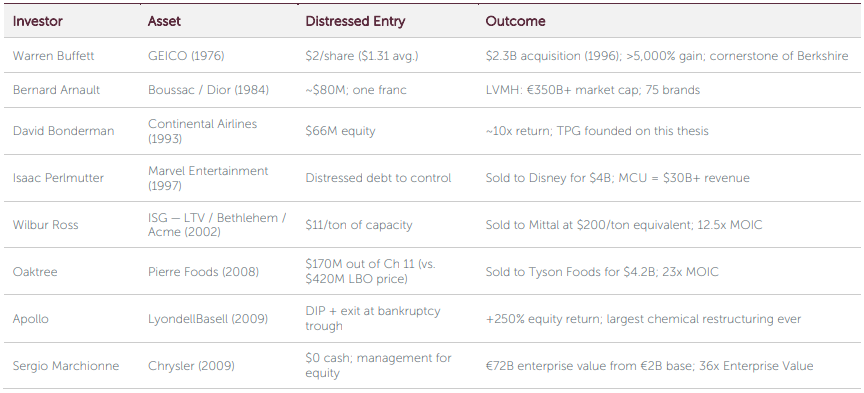
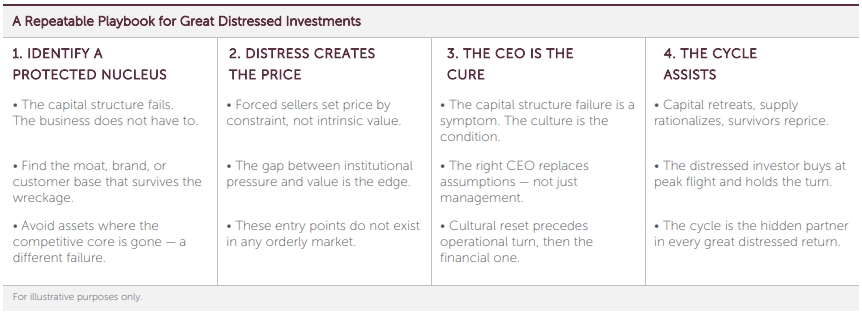
We reviewed eight of the most well-known, “homeruns” in distressed investing. Four tenets appear consistently across all of them.
1. Capital Structure Failure, Not Business Failure
The most important insight in distressed investing is the simplest: a company whose capital structure has failed has not necessarily failed as a business. These are distinct events that markets, in their indiscriminate panic, routinely treat as one.
When debt trades significantly below par, the reflexive market reaction is to generalize that the company is failing. What usually happened is more specific: too much debt was issued at the peak of a microcycle. In the right businesses, the brand, customer relationships and operational infrastructure can survive, often intact, beneath the wreckage of the balance sheet.
GEICO’s direct-to-consumer model, structurally the lowest-cost distribution channel in American auto insurance, was fully intact when the stock fell from $61 to $2 in 1976. Management had mispriced risk. The moat had not failed. Buffett’s assessment: GEICO was “just wounded,” not broken. Similarly, Marvel’s IP library with Spider-Man, the Avengers and Iron Man, was worth billions when Marvel filed for Chapter 11 in 1996. The comic book industry had collapsed. The characters were not worthless.
The foundational question in distressed investing is “what actually failed and what will survive?”
Axar calls this identifying the nucleus: the central competitive advantage (“moat” to use Buffett’s parlance) of the business that can sustain despite the current state of affairs. Inverting the concept, identifying companies where the nucleus is irreparable damaged or gone, is equally important, and one of the most reliable ways to avoid the trap doors that often occur in distressed investing
2. Distress Creates A Price That No Rational Market Would Produce
The mispricing of distressed assets is structural. When forced sellers dominate, like CLOs being penalized for holding defaulted paper or banks clearing positions to preserve capital ratios, the price is set by the seller’s institutional constraints, not the asset’s intrinsic value. That gap is where great distressed investments always start.
In 2002, Wilbur Ross acquired LTV’s steelmaking assets at $11 per ton of capacity. Comparable non-distressed capacity was trading at $200 per ton; the same blast furnaces, integrated mills, and customer relationships at a 95% discount. He assembled LTV, Bethlehem, Acme, and Weirton into International Steel Group and sold it to Mittal for $4.5 billion, 12.5x the original investment. Similarly, Bonderman paid $66 million for Continental Airlines in Chapter 11, which had $10 billion in revenues and irreplaceable gate positions, but the price reflected investor panic, not intrinsic value. Arnault paid one franc for Christian Dior.
These prices emerge only when sellers have no choice: the clock is running, the mandate is violated and a company needs fresh cash. The investors who built lasting institutions from the rubble of distress were not waiting for clarity. They were buying into the confusion itself, at the precise moment when forced selling was most intense.
3. The New CEO Is the Critical Variable and Must Arrive with a Full Mandate
Price explains why the opportunity exists. Management determines whether the institution endures.
A distressed company is not just overleveraged. It carries the accumulated dysfunction of the decisions that caused it to fail, which are often bad incentives, eroded accountability, and a tolerance for underperformance embedded in the organization.
The capital structure failure is a symptom. The culture is the underlying condition. Financial restructuring addresses the former. A new CEO with a clear mandate addresses the latter. The best analogy is a full course of antibiotics: effective only at full dose, to the right pathogen, by a practitioner who knows what they are treating. A new leader who operates cautiously within the existing culture, deferring to incumbents, preserving legacy structures, produces only temporary improvement and often stronger resistance, not lasting growth. Similarly, a leader bent on burnishing his or her legacy through “empire building” or M&A to gain scale, can also miss out on targeting cultural dysfunction that needs to be addressed to create a lasting company. Several examples of successful CEO hires, with the right leadership mindset and approach, demonstrate the impact they have had on an organization’s trajectory.
Buffett identified Jack Byrne before acquiring his most significant GEICO position. Byrne cut half the workforce, exited unprofitable states, hiked rates 40%, and negotiated a $75 million reinsurance facility that restored statutory capital within a year. “There aren’t many Jack Byrnes in the managerial world,” Buffett wrote, “or GEICOs in the business world.”
Bonderman installed Gordon Bethune at Continental almost immediately after taking control. Bethune, a Boeing manufacturing veteran with no airline experience, gathered the company’s 800-page operations manual and burned it in the parking lot. He set one goal: get the planes to arrive on time. When Continental first hit the target, every employee received a $65 check.
Oaktree’s turnaround of Pierre Foods follows the same template. Acquired out of bankruptcy in 2008 for $170 million versus the prior owner’s $420 million LBO price, Oaktree installed John Simons, a ConAgra and Cargill veteran, as CEO; he expanded EBITDA margins from 11% to nearly 19% through disciplined operational improvement and bolt-on acquisitions. AP was sold to Tyson Foods in 2017 for $4.2 billion (23x MOIC), Oaktree CIO Bruce Karsh called it “one of the all-time great private equity investments.”
The pattern is consistent. The new CEO is not hired to manage the existing organization. They are hired to replace its assumptions, its incentive structures, and its relationship with accountability. The most important work happens in the first year. The financial results follow.
A distressed asset without an identified management solution is a financial trade. With the right leader installed with full authority, it is an institution-building opportunity. The controlling investor, like Axar, must deliver the new CEO.
4. Mean Reversion Is the Hidden Partner
Distress rarely happens in isolation. It is almost always the product of a traditional capital cycle: excess profit leads to new capacity/capital, cheap debt is available, overcapacity follows, financial stress, capital retreat, supply rationalization, and eventual recovery. The patient distressed investor is buying the mean reversion that follows when capital exits a distressed industry.
Wilbur Ross’s U.S. steel industry from 1998 to 2005 is the purest example. More than 30 companies went bankrupt. Capital fled entirely. Then a 30% US steel tariff and China’s infrastructure buildout created a demand surge that a rationalized U.S. industry was uniquely positioned to dramatically exploit. Ross had bought trough assets cheap when capital retreat was at its peak. He sold ISG in the year global steel prices reached a generational high, patiently waiting for the mean reversion potential in that industry.
The same pattern played out in U.S. airlines in the early 1990s. Pan Am and Eastern had liquidated. Delta, TWA, and Continental had filed Chapter 11. The competitive field was winnowed dramatically. Bonderman bought not just Continental, but the recovery of the entire rationalized industry at Continental’s distressed price. LyondellBasell in 2009 added a structural layer: the U.S. shale gas revolution collapsed natural gas prices from $13 to $2–3 per thousand cubic feet, handing U.S. petrochemical producers a feedstock cost advantage their competitors couldn’t match. Apollo bought the trough of the cycle at precisely the moment that structural shift was beginning.
The distressed investor buys into capital flight when passive investors are structurally forced out. No other investment category provides systematic access to the bottoming of the capital cycle. We believe direct lending is now entering the same pattern: substantial capital raised when returns looked strong, now worsening underlying credit, constrained holders, and the early stages of forced portfolio turnover.
KEY TAKEAWAYS
-
Distress unlocks the right conditions for alpha when the balance sheet fails but the business does not. The investor’s edge is identifying what survives beneath the wreckage (brand, customer relationships, operational infrastructure) before the market does. Axar calls this identifying the core, defensive nucleus
-
Attractive entry prices emerge from seller constraint. CLOs, banks, and mandate-constrained funds sell not because the asset has totally failed, but because they cannot hold it through the distress including the need for additional funding to facilitate the recovery. That structural gap between institutional constraint and intrinsic value is a significant source of returns and a core advantage for Axar.
-
The most attractive opportunities often demand a leadership change and a capital cycle turn (not just debt reduction). The right CEO, installed with full authority early, addresses the cultural conditions that caused the failure. The investor who holds through the capital retreat captures the asymmetric recovery.
CONCLUSION
The patterns discussed were true when Arnault paid one franc for a bankrupt textile company, when Buffett identified a single insurance executive before buying a distressed GEICO at $2 per share, when Ross assembled a rationalized steel industry from four bankrupt producers and sold it at the cycle peak, and when Apollo bought the largest chemical bankruptcy in history just as the shale revolution was beginning.
The volume of current distress is real (10% of the syndicated loan market now trading below 80% of par), LME exhaustion is producing real control transfers, and the direct lending complex ($1.5 trillion deployed at peak-cycle terms) is beginning to surface credit stress that the lack of marks have obscured (but with a lot more to come). The forced selling dynamics that produced the incredible entry prices in this memo are taking shape.
The distressed investors who acquire the next generation of lasting institutions will bring three things to that environment: the analytical discipline to separate what failed from what survived; the operational networks to recruit and install the right leaders quickly; and the duration of capital to hold through the cycle turn.
Axar is built to capitalize on this present reality and find the next great distressed investment.
DISCLAIMER
Axar Capital Management LP (“Axar”) has prepared this memo (“Memo”) for informational purposes only. This Memo is not intended to constitute legal, tax, financial, or investment advice.
While all the information contained in this Memo is believed to be accurate, no guarantee, representation or warranty is made as to the accuracy, completeness or fairness of the information contained in this Memo. Certain information in this Memo reflects the current opinions of Axar which may prove to be incorrect and are subject to change. Certain information contained in this Memo constitutes “forward-looking statements,” which can be identified by the use of forward-looking terminology such as “may,” “will,” “should,” “expect,” “anticipate,” “target,” “project,” “estimate,” “intend,” “continue,” or “believe” or the negatives thereof or other variations thereon or comparable terminology. Due to various risks and uncertainties, actual events or results may differ materially from those reflected or contemplated in such forward-looking statements.
Each recipient further agrees that it will (i) not copy, reproduce, or distribute this Memo, in whole or in part, to any person or entity; (ii) keep permanently confidential all information contained herein that is not already public; and (iii) use this document solely for the purpose set forth in the first paragraph above.
Topics:
.png?width=2400&height=1257&name=73618-%20Axar-%20Blog%20%2310%20-%20derived%20from%20The%20Chopping%20Block%20-%20Feature%20Image%20(1).png)



.png?width=1200&height=628&name=Untitled%20design%20(18).png)







.jpg?width=360&height=203&name=imgi_13_648847-img_bars%20(1).jpg)