---
title: "From Grave Concerns to Growth: The Everstory Revival"
description: Discover how Axar Capital transformed StoneMor Inc. into Everstory Partners, revitalizing a struggling business through strategic leadership and operational excellence.
image: https://insights.axarcapital.com/hubfs/imgi_17_648850-imgVariant2.png
---
[Skip to main content](https://insights.axarcapital.com/from-grave-concerns-to-growth-the-everstory-revival#maincontent)
- [Home](https://axarcapital.com/)
- [About](https://axarcapital.com/about)
- [Our Values](https://axarcapital.com/our-values)
- [Approach](https://axarcapital.com/approach)
- [Team](https://axarcapital.com/team)
- [Careers](https://axarcapital.com/careers)
- [News & Insights](https://insights.axarcapital.com/)
- [Contact](https://axarcapital.com/contact)
- [Login](https://access.hedgeserv.com/wauth/login)
[« View All Posts](https://insights.axarcapital.com)
# From Grave Concerns to Growth: The Everstory Revival
March 30th, 2026
11 min read
By [Axar Capital Management LP](https://insights.axarcapital.com/author/axar-capital-management-lp)

There are roughly 3 million deaths in the United States every year. That number does not
fluctuate meaningfully with interest rates, inflation, or geopolitical turbulence. The families
who bury their loved ones do not choose the timing.
Yet by 2017, the company serving more of those families than almost anyone else in America had become a financial and operational wreck, burning cash, hemorrhaging talent, and its debt traded at distressed levels. That company was StoneMor Inc. Axar saw something most did not: beneath the dysfunction, lay a genuinely essential, defensible business with durable pricing power and a unique financial asset hiding on the balance sheet. What followed is an example of the Axar playbook in action: investing behind a broken business, rebuilding it from within, focusing on the customer and positioning it for durable value creation.
## COMPANY BACKGROUND
StoneMor Inc., now operating as Everstory Partners, is the largest private owner and operator of cemeteries and funeral homes in the United States (#2 in the US after publicly listed SCI). The company operates 469 properties across 23 states, serving over 65,000 families annually. Its footprint spans 376 cemeteries, 81 funeral homes, and 12 crematories, generating over $435 million in annual revenue with approximately 2,650 employees, headquartered in Winter Park, Florida.

The aspects of this opportunity that drew Axar’s attention were not in the financial statements; they were the potential of a company with an ineffective leadership team and unrecognized assets. Founded in 1999, StoneMor Inc. consolidated small family-owned cemeteries and funeral homes across the US, electing to operate with MLP tax status as a result of the private equity strategy that backed the roll-up. The long-tenured leadership team had neglected the company’s culture and was more focused on distributions to their private equity owner (related to the flawed MLP structure) rather than sustainable investment in the business. In terms of unrecognized assets, embedded within the business was a $750MM pre-need & merchandise trust, which is a regulated fund holding assets related to pre-purchased burial services or longterm maintenance requirements of the cemetery. Preneed is a key focus of the industry, representing greater than 60% of Everstory revenue. Unlike at-need sales, which are paid in full when funeral or cemetery services are delivered and are largely tied to death rates, pre-need sales are made in advance of death and typically include prepaid services and merchandise purchased over time. A substantial portion of those pre-need customer payments is placed into trust, which Everstory invests and manages. As a result, pre-need growth depends less on underlying mortality trends and more on the strength and discipline of the company’s sales team
This trust is managed by a captive registered investment advisor (RIA), a unique financial asset that most high-yield investors were ignoring as the distressed unfolded. For Axar, this was the kind of structural value that has tended to pull us into a distressed situation (the “hidden asset”).
## AXAR UNEARTHS AN OPPORTUNITY
Serious cracks first started appearing in the company from an exogenous event when commodity prices collapsed in 2015, as the entire publicly listed MLP universe, energy and non-energy alike, sold off sharply and lost access to additional equity financing as a result. Moreover, the historical, internal mismanagement within the company made its structure weak and vulnerable to such shocks. The company had publicly traded stock, which was thinly traded and vulnerable to large changes in price, but that stock was being relied on to issue additional equity to fund the operation. The company announced a 50% cut to its shareholder distribution, resulting in a 64% decrease in stock price. Headwinds had resulted in a material decline in financial performance, resulting in the company being unable to make shareholder distributions and defaulting on its JPMorgan-led credit facility. The company’s CEO and CFO resigned, amid weak financial and stock performance as well as missed financial reporting deadlines. The company was spiraling and hemorrhaging cash while facing operational headwinds and accounting / regulatory distractions. Additionally, there was the looming industry headwind of developing a comprehensive strategy to address cremation. Yet, where most onlookers saw a morbid company ready for the grave, Axar saw a significant, underappreciated opportunity.
The entry thesis was straight from the Axar playbook: acquire the debt of a deeply stressed but fundamentally sound business at a meaningful discount with significant downside protection, then actively engage to fix what was broken. Axar envisioned the exit at entry: a cleaned-up, cash-generative platform with barriers to entry that could attract multiple strategic acquirors at a compelling multiple. The margin of safety was the business itself; the upside was the transformation. Core to the downside aspect of the thesis was the ability to liquidate individual assets in a Chapter 11 filing. If all else failed, Axar had a high degree of confidence that the distressed debt would be covered in a liquidation scenario.
The underlying business had properties that Axar prizes: it operated in a local, relationship-intensive industry with genuine pricing power and no meaningful substitute. One cannot outsource or offshore a burial. One cannot buy a cemetery plot online from a competitor in another state. The business is, by its nature, deeply local, recurring, and largely immune to macroeconomic cycles. For many families, there is a strong familial, cultural and /or religious connection to a particular cemetery, which means they have no interest in shopping around. And the then $750MM trust (today having grown to over $1 billion), generating management fee income through the captive RIA, was a durable, underearning financial asset sitting inside an operational mess that was obscuring its value to others.
Axar began aggressively acquiring the debt and actively engaging with the company. A Sunday phone call from the company’s Chairman to Axar’s CEO in February 2019 permanently changed the trajectory of the company. StoneMor had lost access to its revolver due to another default and was at risk of missing payroll in just two weeks. Axar originated a $35 million rescue line, sitting between the distressed high-yield bonds (senior to those bonds) and the JPMorgan-led revolver. Axar simultaneously helped the Company enter into a six-month forbearance with JPMorgan, giving Axar and the company time to restructure the full balance sheet.
This occurred by July (five months later) with a Goldman Sachs-led lender groupC, refinancing the entire capital structure (including Axar’s rescue loan) and Axar backstopped a rights offering to emerge as a 51% owner, appointing three of seven new directors to the Board. Crucially, Axar’s CEO Andrew Axelrod was elected as Chairman.
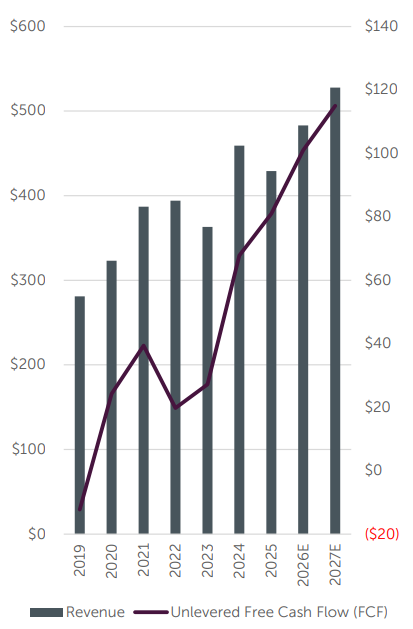
At this time, the future of the company was far from clear. In fact, the company continued to struggle, reaching only $281 million of revenue against unlevered FCF of negative $12 million at the trough. The problems of mismanagement were systemic. High turnover was endemic at every level of the organization. The company had cultivated a reputation as a difficult place to work, with a remote and disconnected corporate workforce. Morale was poor. The sales infrastructure was antiquated, contracts were managed on paper, and there was no meaningful business intelligence capability. The leadership and cultural foundation were completely broken.
The turnaround paused during the COVID-19 pandemic as the challenges and demands upon a deathcare business during that time became the only area of focus. This resulted in a temporary improvement in financial performance, buying existing management time, but by early 2022 the same broken leadership and cultural issues began to reappear.
This opened the door for Axar to make its final move and take the company private in order to complete a proper turnaround. By executing on the November 2022 take-private transaction, Axar controlled 100% of the company and was able to effectuate the turnaround. First, getting the right CEO and leadership team on board was crucial to the resuscitation of this company.
## BUILDING FROM THE INSIDE OUT: THE LILLY DONOHUE PLAYBOOK
Axar’s most important decisions are often about people, not investable securities. Securities give you access to the company, but they are not the sole driver of value. In November 2022, as Axar took the company private, it recruited Lilly Donohue as CEO of Everstory Partners. The appointment was deliberate and carefully considered. Axar was not looking for a financial engineer. Rather, it was looking for someone who had demonstrated she could take a languishing platform and transform it into a valuable winner, as she had done at Holiday Retirement, formerly the largest independent senior living owner and operator in the United States with over 300 communities in 46 states at the time. Axar was looking for a leader who understood that the operational and cultural dysfunction was the problem, and that fixing those would unlock the financials, not the other way around.
Lilly’s approach was methodical. She did not arrive with a 100-day plan of dramatic restructuring. She observed first, taking in her environment. She evaluated people carefully, preserving institutional knowledge before making changes. Her first major initiative was to raise the minimum wage to $15 per hour, financed by restructuring sales commissions. This was not a gesture; rather, it was a signal. And within 18 months, Everstory achieved “Great Place to Work” certification based entirely on anonymous employee feedback. To be certified, the company earned the real-time feedback of employees regarding their company culture with approximately 80% of Everstory’s 2,650 employees returning surveys sharing their thoughts on working at the company. The company that had been known as a difficult place to work had become one where its employees were proud to work.
The operational transformation was equally disciplined. Headcount and SG&A were reduced by approximately 40% - but crucially, while simultaneously improving employee satisfaction scores. This was not a blunt cost-cutting exercise; it was a structural redesign with a scalpel. She installed a revamped sales team, digitized contracts and collections, and built an enhanced business intelligence dashboard from scratch. Most consequentially, Lilly launched a systematic effort to digitize Everstory’s burial plot inventory, including decades of paper-based burial records across hundreds of locations, using a software called Plotbox, to understand inventory in real time and allow for dynamic pricing decisions. As of this writing, the digitization effort is nearly 50% complete and on pace for full completion by the end of 2026. When complete, it will unlock capabilities in customer service, sales, and capital allocation that the company never previously had.
## THE NUMBERS THAT FOLLOWED
The financial results since Lilly’s arrival have been striking. In 2019, the company was generating negative $12 million in unlevered free cash flow on $281 million of revenues. By 2025, just three years after Lily took over as CEO, revenues had grown to $430 million and unlevered FCF had reached over $80 million.
That is a transformation of nearly $90 million in increased annual free cash flow from a business that was effectively cash-flow negative at the time of our entry, and the trajectory is still pointing upward. The goal is to reach $100 million in free cash flow before putting the company up for sale, a milestone that will demonstrate the full arc of the turnaround.
The performance table below illustrates this trajectory in Unlevered Free Cash Flow (FCF), showing the significant growth experienced during the turnaround, following years of stagnation. Lilly joined in November 2022, which is an inflection point in the company’s performance and growth path.
#### Revenue and Unlevered Free Cash Flow (FCF)1
## CHALLENGES NAVIGATED AND OPPORTUNITY AHEAD
This investment has not been without its complexities. Turnarounds of this scale and depth are challenging, especially in a poorly understood and fragmented industry. The scattered geography of the business, with 469 properties across 23 states, creates inherent management challenges. Each state has its own unique regulations, and each locality has its own flavor, whether cultural, religious, or based on local customs. In many respects, this was a real estate play with a community-based, localized dimension. Maintaining consistent service quality and culture across hundreds of individual sites, each with its own staff and community relationships, requires a caliber of organizational discipline that takes years to build. There is also a profound human element to the service they provide, as families and friends navigate vulnerable moments in their lives, difficult junctures that demand focused, thoughtful, and compassionate customer care. A cookie-cutter approach to improving sales and customer service was not going to work in an industry such as deathcare with its unique features and idiosyncrasies.
Applying the Axar playbook, Everstory today is a fundamentally different company than the one Axar initially entered. Free cash flow has grown from negative level to $80+ million annually - with a goal of reaching $100 million - the culture has been rebuilt, and the operational infrastructure has been modernized.
The inventory digitization program is the most important near-term catalyst. Once the full inventory is digital, Everstory will, for the first time, have a real-time, searchable record of every burial plot across every cemetery it operates. It will transform the company’s ability to price dynamically, serve families more effectively, and execute targeted sales and marketing at scale. The impact on revenue per location and on working capital efficiency will be material. It will provide crucial real-time data and financial information to the management team that will be critical for optimizing decision-making and identifying weaknesses and opportunities in the business.
The trust optimization opportunity is equally significant. Everstory manages $1.1 billion of trust assets through its captive RIA. This trust has historically been underinvested and allocated in a way that prioritized liquidity for a liability pool with over 15 years of average duration, which suppressed investment returns. As Axar, management, and the CIO optimize the asset allocation strategy within applicable regulatory framework, the incremental RIA fee income represents a direct contribution to EBITDA that requires no additional capital, no incremental headcount, and no added operational complexity. It is simply a more rational deployment of assets the company already manages. Continued growth of this trust asset is a crucial continued driver of value.
M&A is the third driver and area of continued focus. Everstory has developed a disciplined acquisition playbook for cemetery properties — a fragmented asset class whereby applying Everstory’s systems, culture, and technology to a newly acquired location generates rapid value accretion. Individual cemetery businesses are highly local and rarely attract sophisticated buyers. That suits Axar’s approach precisely: limited competition, a clear operational thesis, and the ability to move with conviction. Recent acquisitions validate the thesis: the Park Lawn portfolio acquisition in December 2023 added 85 locations and $120 million in repositioned trust assets for a $70 million purchase price, and the Sunset Hills acquisition in November 2024 added a 160-acre Flint, Michigan cemetery with $58 million in trust assets for just $11 million. The M&A pipeline remains active, with targets typically available at ~5x FCF and below 1.0x trust asset value.
Finally, there is the exit. Axar underwrote this investment with multiple strategic buyers in mind from the beginning. Public deathcare comparables trade at over 17x FCF, and recent M&A precedents in the sector have cleared 20x FCF. A business generating $100– $115 million in annual unlevered FCF by the target exit window, with clear visibility from digitization, trust optimization, and bolt-on M&A, should attract serious strategic interest at a compelling valuation. There are a variety of potential buyers of the business, including traditional PE LBO buyers, strategic deathcare companies, and alternative asset managers who have significant efficiencies in the investment of the trust assets. This depth and breadth of potential buyers should generate a competitive process. The team is building toward that process from a position of operational strength.
## CONCLUSION: WHAT EVERSTORY REPRESENTS
Everstory encapsulates Axar at its best. The investment was entered through stress, when forced sellers were looking for liquidity and the market was focused on dysfunction rather than the underlying business. Axar was patient in building its position, expanding exposure as conviction increased and risk decreased. Axar recruited a CEO with strong leadership skills who understood that culture and operations were the root cause of dysfunction. She was trusted with the time and resources to fix the business properly, from within. The team has maintained active involvement throughout: on the board, engaged with management on strategy, capital allocation, and the path to exit.
Everstory’s failures were not peripheral; in an enterprise defined by trust, its culture, leadership, and operational discipline had all broken down. Since Axar’s involvement, the company has been rebuilt from the inside out, with new leadership, a cultural reset, stronger frontline investment, modernized sales and systems, a digitized operating backbone, an optimized trust, and a disciplined growth strategy. What has emerged is not simply a stabilized company, but a fundamentally stronger enterprise that recently achieved “Great Place To Work” status and has seen drastic improvement in customer satisfaction scores. When employees and customers are firmly behind an organization, the financial results and value creation will follow.
## DISCLOSURE
Axar Capital Management LP (“Axar”) has prepared this confidential presentation (“presentation”) for informational purposes only.
The case study included in this presentation was selected based on objective, non-performance based criteria, namely that such portfolio company, in Axar’s opinion, is illustrative of Axar’s investment philosophy. The company identified does not represent all of the securities purchased, sold, or recommended by Axar.
Certain information contained in this presentation constitutes “forward-looking statements,” which can be identified by the use of forwardlooking terminology such as “may,” “will,” “should,” “expect,” “anticipate,” “target,” “project,” “estimate,” “intend,” “continue,” or “believe” or the negatives thereof or other variations thereon or comparable terminology. Due to various risks and uncertainties, actual events or results may differ materially from those reflected or contemplated in such forward-looking statements. There is no guarantee Axar will be successful in achieving its objectives. Past performance is not indicative of future results.
While all the information contained in this presentation is believed to be accurate, no guarantee, representation or warranty is made as to the accuracy, completeness or fairness of the information contained in this document. Projected financial information and other forward-looking statements do not, nor are they intended to, constitute a promise of actual results. Such information and forward-looking statements involve known and unknown risks, uncertainties and other important factors that could cause actual results, performance, achievements or industry results to differ materially from the financial information, projections and estimates included in this presentation.
Certain information contained in this presentation is non-public, proprietary, and highly confidential and is provided to selected recipients only on a confidential basis. Accordingly, by accepting this presentation, the recipient acknowledges and agrees that it will maintain the information and data contained herein in the strictest of confidence and will not reproduce this presentation or disclose any of the contents hereof to any other person unless permitted by Axar.
This document is not intended to constitute legal or tax advice and is not an investment recommendation.
## DISCLAIMER
(1) For 2026E and 2027E, management estimated based on internal forecasts and assumptions; all in $MM
Topics:
[Insights](https://insights.axarcapital.com/topic/insights)
Don't forget to share this post:
## Related Articles
### [.png?width=2400&height=1257&name=73618-%20Axar-%20Blog%20%2310%20-%20derived%20from%20The%20Chopping%20Block%20-%20Feature%20Image%20(1).png) The Nucleus: Why a Failed Balance Sheet Doesn’t Mean a Failed Business September 24th, 2026|11 min read](https://insights.axarcapital.com/the-nucleus-why-a-failed-balance-sheet-doesnt-mean-a-failed-business)
### [ The AI Value Gap August 21st, 2026|11 min read](https://insights.axarcapital.com/the-ai-value-gap)
### [ Switching Costs, The Moat Customers Don't Notice They're Trapped By August 19th, 2026|11 min read](https://insights.axarcapital.com/switching-costs-the-moat-customers-dont-notice)
### [ The Compounders Built on Overlooked Balance Sheets August 5th, 2026|11 min read](https://insights.axarcapital.com/compounders-built-on-overlooked-balance-sheets)
### [.png?width=1200&height=628&name=Untitled%20design%20(18).png) 2026 2H Market Outlook – the “Velvet Rope Market” July 9th, 2026|11 min read](https://insights.axarcapital.com/2026-2h-market-outlook-velvet-rope-market)
### [ Active vs. Passive in Distressed Credit: Why Showing Up at the Table Changes the Outcome June 18th, 2026|11 min read](https://insights.axarcapital.com/active-vs-passive-distressed-credit)
### [ The PE Overhang: Why Sponsors Are Stuck and What It Means for Credit June 3rd, 2026|11 min read](https://insights.axarcapital.com/private-equity-overhang-dpi-credit-markets)
### [ What Happens to a Company After a Liability Management Exercise May 20th, 2026|11 min read](https://insights.axarcapital.com/what-happens-after-liability-management-exercise)
### [ CLOs Own 75% of the Leveraged Loan Market. Here's Why That Creates Pricing Anomalies. May 6th, 2026|11 min read](https://insights.axarcapital.com/clo-overcollateralization-leveraged-loan-pricing-anomalies)
### [ The Chopping Block: The Anatomy of a Great Distressed Investment April 24th, 2026|11 min read](https://insights.axarcapital.com/the-chopping-block-the-anatomy-of-a-great-distressed-investment)
### [ The Lenders Who Left: How a Decade of Easy Money Quietly Reshaped the Distressed Credit Landscape April 22nd, 2026|11 min read](https://insights.axarcapital.com/the-lenders-who-left-distressed-credit-landscape)
### [ Credit Quality in Decline — Why the Middle Market Is Axar's Hunting Ground April 10th, 2026|11 min read](https://insights.axarcapital.com/credit-quality-in-decline)
### [.jpg?width=360&height=203&name=imgi_13_648847-img_bars%20(1).jpg) 2026 Market Outlook January 19th, 2026|11 min read](https://insights.axarcapital.com/2026-market-outlook)
### [ The Chopping Block: Building Culture- How Two CEOs Turned Distress into Durable Growth November 11th, 2025|11 min read](https://insights.axarcapital.com/the-chopping-block-building-culture-how-two-ceos-turned-distress-into-durable-growth)
### [ Credit Unbound IV: Capitalizing on a Shifting Opportunity Set October 27th, 2025|11 min read](https://insights.axarcapital.com/credit-unbound-part-4)
### [ Credit Unbound III: Capitalizing on a Shifting Opportunity Set September 15th, 2025|11 min read](https://insights.axarcapital.com/credit-unbound-part-3)
### [ Credit Unbound II: Capitalizing on a Shifting Opportunity Set September 8th, 2025|11 min read](https://insights.axarcapital.com/credit-unbound-part-2)
### [ Credit Unbound I: Capitalizing on a Shifting Opportunity Set September 1st, 2025|11 min read](https://insights.axarcapital.com/credit-unbound-part-1)
### [ The Chopping Block: Chipping Away at the LME Opportunity June 20th, 2025|11 min read](https://insights.axarcapital.com/the-chopping-block)
### [ When The Music Stops March 3rd, 2025|11 min read](https://insights.axarcapital.com/when-the-music-stops)
### [ Cashing In On Cash Now October 15th, 2024|11 min read](https://insights.axarcapital.com/cashing-in-on-cash-now)
### [ Jailbreaking Value July 1st, 2024|11 min read](https://insights.axarcapital.com/jailbreaking-value)
- [Home](https://axarcapital.com/)
- [About](https://axarcapital.com/about)
- [Our Values](https://axarcapital.com/our-values)
- [Approach](https://axarcapital.com/approach)
- [Team](https://axarcapital.com/team)
- [Careers](https://axarcapital.com/careers)
- [News & Insights](https://insights.axarcapital.com/)
- [Contact](https://axarcapital.com/contact)
- [Login](https://access.hedgeserv.com/wauth/login)
© 2026 Axar Capital Management LP. All Rights Reserved.
Privacy Policy. Terms Of Service.
```json
{
"@context" : "https://schema.org",
"@type" : "BlogPosting",
"author" : {
"@type" : "Person",
"name" : "Axar Capital Management LP",
"url" : "https://insights.axarcapital.com/author/axar-capital-management-lp"
},
"dateModified" : "2026-04-06T18:54:45.284Z",
"datePublished" : "2026-03-30T15:00:00.000Z",
"headline" : "From Grave Concerns to Growth: The Everstory Revival",
"image" : [ "https://insights.axarcapital.com/hubfs/imgi_17_648850-imgVariant2.png" ],
"mainEntityOfPage" : {
"@id" : "https://insights.axarcapital.com/from-grave-concerns-to-growth-the-everstory-revival",
"@type" : "WebPage"
},
"publisher" : {
"@type" : "Organization",
"logo" : {
"@type" : "ImageObject",
"url" : "https://insights.axarcapital.com/hubfs/Logo/Axar_logo.png"
}
}
}
```