
A revenue decline and a customer defection look identical on a P&L. They are not the same event, and confusing them is one of the more expensive mistakes an investor can make in distress. A business bleeding revenue because customers are leaving is a different animal than one bleeding revenue while its customer base stays locked in place by friction they can't easily walk away from.
Distressed businesses get read one way by default: revenue is down, therefore the franchise is weakening. That reading is sometimes right. It is also, often enough to matter, an incomplete picture.
Two Businesses, One Bad Quarter
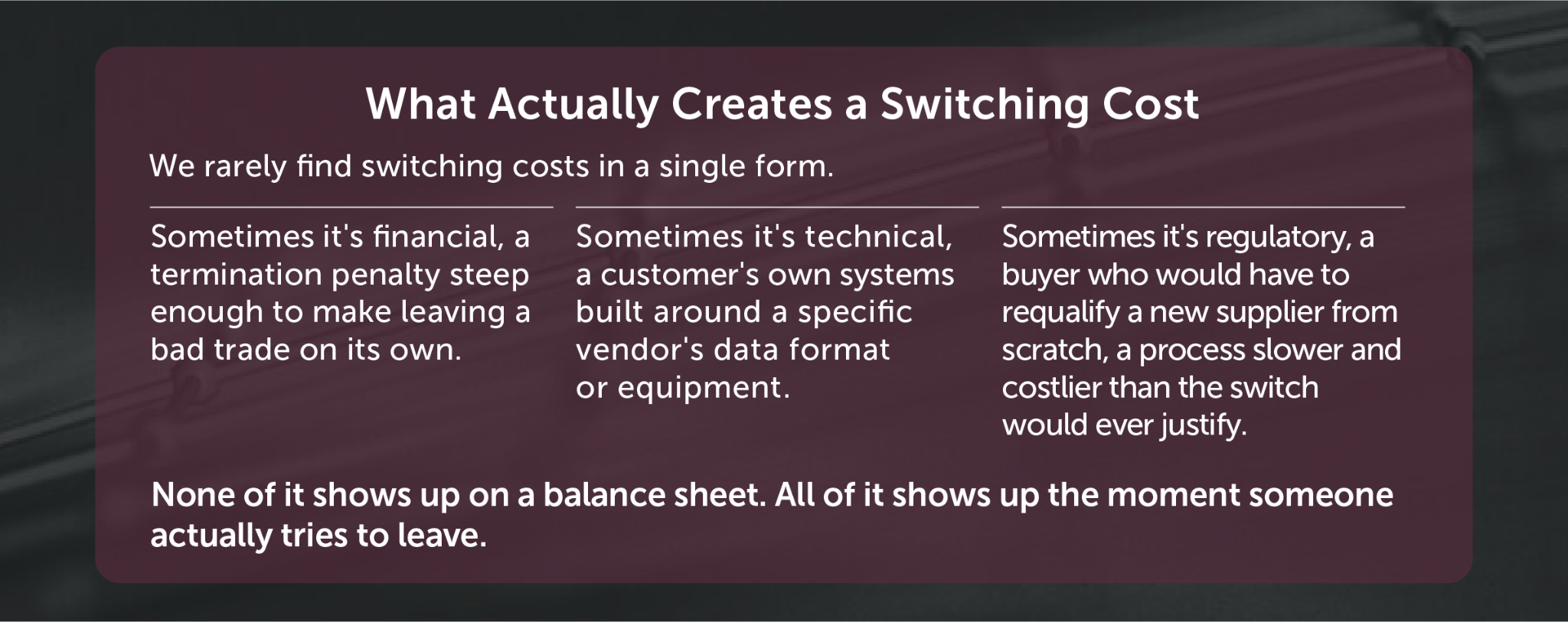
Take two specialty distributors, both down 15% in revenue this year, for reasons that look identical on a term sheet. One cut prices to defend volume after a competitor undercut it, and its customers are actively pricing alternatives right now. The other lost revenue because its largest customer trimmed order volume in a soft cycle, while staying bound to the distributor's proprietary ordering system, a multi-year supply agreement, and a requalification process expensive enough to make switching not worth the trouble. Same top-line number. Only one of these is actually losing its franchise, and this is the distinction we spend the most time on when a name shows up on a downgrade list.
Where This Moat Lives in the Middle Market
Specialty distributors and regulated service providers are natural homes for this kind of advantage. These are businesses that rarely have a recognizable brand or a patent to point to, which is exactly why the moat gets missed. A CLO facing an overcollateralization test doesn't pause to ask why a loan's underlying revenue fell before it sells.
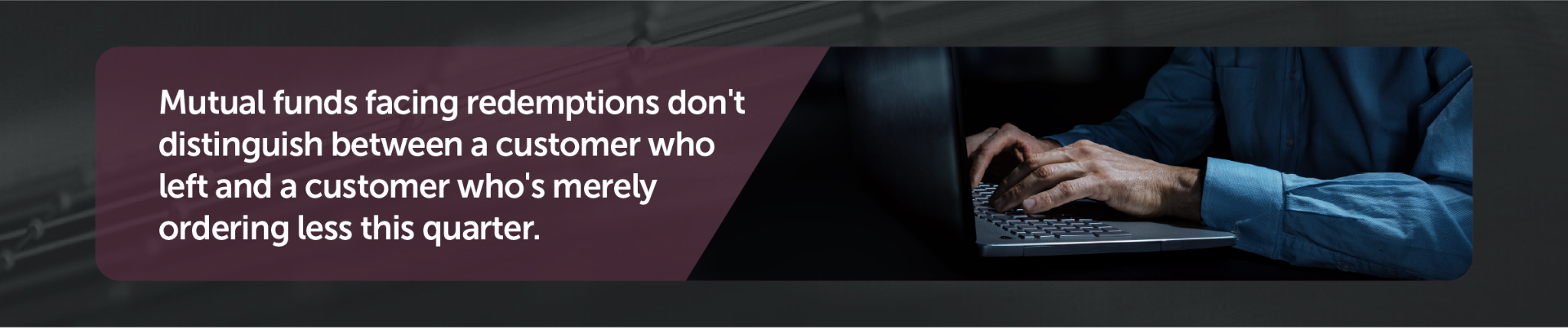
The forced selling that distress creates treats both businesses identically, even when only one of them has actually lost its franchise.
Reading Past the Revenue Line
We ask a different question than the market does. Not why revenue is down, but whether the customer actually left, or is still structurally captive. A business with genuine switching costs can survive a bad year, a bad sponsor, even a bad balance sheet, because the thing that makes it valuable was never the revenue line in the first place. It was the friction nobody sees until somebody tries to walk away.
Why This Gets Missed So Often
Analysts read a P&L left to right, and a P&L only shows one number: revenue. It doesn't show a churn rate, a requalification timeline, or a termination penalty schedule, all of which live in contracts and operating agreements most distressed-debt buyers never open. A CLO manager staring down an overcollateralization test is working against a clock measured in days, not the weeks it would take to actually read the customer contracts underneath a downgraded credit. The selling happens on the number that's visible. The moat, if there is one, lives in the numbers that aren't.
That's the gap we seek to close. Not risk nobody else will take, but diligence that may be overlooked.
This is also why switching costs age well as a moat category, better than some of the more celebrated ones. A brand can fade with a single bad product cycle. A network effect can be disrupted by a platform shift. A contractual, technical, or regulatory lock-in doesn't erode just because a company had a rough year. It erodes only when a competitor solves the actual friction, a much harder and slower thing to do than simply outspending on marketing.

This material is provided for informational purposes only and does not constitute an offer to sell or a solicitation of an offer to buy any securities or investment advisory services. The views expressed herein are those of Axar Capital as of the date of publication and are subject to change without notice.
This material is not intended to provide, and should not be relied upon for, investment, legal, or tax advice. Any forward-looking statements or discussions of potential outcomes are based on current expectations and assumptions and are subject to change. There can be no assurance that any investment strategy will be successful or that any outcomes discussed herein will be achieved. References to specific investments are provided for illustrative purposes only and do not represent all investments made by Axar Capital. Past performance is not indicative of future results.
FAQ Section
How do you verify a switching cost is real before underwriting a credit, rather than taking a company's own account of it at face value?
We look for evidence in the contracts themselves, termination penalties, integration specifics, requalification requirements, rather than relying on management's characterization of customer loyalty. A switching cost that can't be traced to a specific financial, technical, or regulatory mechanism isn't one we'll underwrite as durable.
What distinguishes a customer that's structurally captive from one that's simply ordering less this quarter?
The presence of friction that would make leaving costly, a contract term, a technical dependency, a requalification process, not just a lack of stated intent to leave. Absent that friction, a quiet customer is not the same thing as a captive one.
Does this change how you approach recovery analysis in a workout compared to a standard distressed underwrite?
It can. A business with genuine switching costs may retain enterprise value through a restructuring that a comparable business without them would not, which affects how we think about where value settles in the capital structure.
If switching-cost businesses are mispriced during distress, why don't more distressed-debt investors already account for this?
Structurally constrained sellers are working against a clock. A CLO manager facing an overcollateralization test doesn't have the time to read the customer contracts underneath a downgraded credit before selling. The selling happens on the number that's visible.
Are there industries where switching costs look durable on paper but tend to erode faster than expected?
Yes, generally where the underlying friction is contractual rather than technical or regulatory. A contract term can be renegotiated. A regulatory requalification process or a deeply embedded technical integration is slower and more expensive to work around, and tends to hold up longer under pressure.
About Axar Capital Management
Axar Capital Management LP is a $3.3 billion opportunistic investment manager focused on U.S. middle market companies with $200 million to $800 million in debt outstanding. Founded in 2015 and 100% employee-owned, Axar specializes in complex situations where traditional institutional capital operates inefficiently. The firm is headquartered at 402 W 13th Street, New York, NY.
Disclaimer: Axar Capital Management LP ("Axar") has prepared this content for informational purposes only. This content is not intended to constitute legal, tax, financial, or investment advice. While all information contained herein is believed to be accurate, no guarantee, representation or warranty is made as to its accuracy, completeness or fairness. Certain information reflects the current opinions of Axar which may prove to be incorrect and are subject to change. Past performance is not indicative of future results. Investing involves a material risk of loss. Certain statements herein reflect forward-looking views, which are inherently uncertain and subject to change. Actual results may differ materially.
Topics:
.png?width=2400&height=1257&name=73618-%20Axar-%20Blog%20%2310%20-%20derived%20from%20The%20Chopping%20Block%20-%20Feature%20Image%20(1).png)


.png?width=1200&height=628&name=Untitled%20design%20(18).png)








.jpg?width=360&height=203&name=imgi_13_648847-img_bars%20(1).jpg)