
Part II – A Wider Moat: Reduced Competition in Middle Market Credit
In this Insight Series, we share perspectives on the evolving opportunistic credit competitive landscape and its impact on today’s investment opportunity set. In this second installment, we examine the trend of diminishing competition in our areas of focus, the factors driving reduced competition in middle market credit opportunities, and why we believe this dynamic is likely to persist.
Ten years ago, when Axar was founded, distressed investing, supported by still relatively recent 2009-10 memories, was fashionable and competitive. The aftermath of the Great Financial Crisis created ample opportunity, generated strong returns and thus attracted new managers and significant capital seeking new investment opportunities. Today, however, the landscape has markedly shifted, leaving a significantly reduced pool of competition, particularly in Axar’s preferred terrain of middle-market distressed debt.
Multiple factors help explain this diminished competition, each offering instructive insights, including: (i) the need for strategy diversification, (ii) the increasing size of opportunistic credit funds, (iii) potential conflicts with other lending strategies, and (iv) strategy complexity.
Strategy Diversification. During the era of near-zero interest rates that persisted from 2010 to 2022, pureplay distressed investors faced a prolonged drought of actionable opportunities. Unable to deploy capital effectively in traditional distressed, many of these managers either shut down or shifted into adjacent strategies (e.g. capital solutions), favoring scale and consistency over complexity and opportunism. The drive toward asset gathering led firms to adopt more predictable and scalable strategies, initially Direct Lending and CLOs, and more recently, originating Capital Solutions, InvestmentGrade private credit, and Asset-Backed debt. These large and now global asset management conglomerates have largely exited the traditional distressed strategy on which many of their reputations were originally built.
As evidence, Figure 1 shows the number of distressed debt funds with strategies similar to Axar’s that were raised each year since 2015. From 2015 to 2021, an average of 12 funds were raised annually (sized between $200 million and $1.5 billion). That average declined to seven per year between 2022 and 2024, with only one comparable fund raised through June 2025.
Scale and Size. The surviving firms have accumulated so much capital that the capital deployment opportunities in the middle market are too small for them to address. See Figure 2 for evidence of the increasing size of fund raises for the distressed strategy these last three years. Given their scale, these investors structure their strategies and processes to rapidly deploy hundreds of millions of dollars per opportunity, rather than tactically selecting the highest-returning opportunities and committing, in many cases, only tens of millions in capital. In summary, many firms have graduated from the middle market to larger opportunities, leaving a vacuum of capital and competition in the middle market, creating an inefficient market for Axar to exploit.
As Axar has seen firsthand, the very firms once eager to own a capital structure’s fulcrum security and lead a restructuring have allocated their resources away from these situations, deeming complicated and nuanced deals, especially in the middle market, too small, too complex, and too slow to move the needle on AUM growth or GP economics.
Distressed Debt Funds: Number Raised by Year (i)
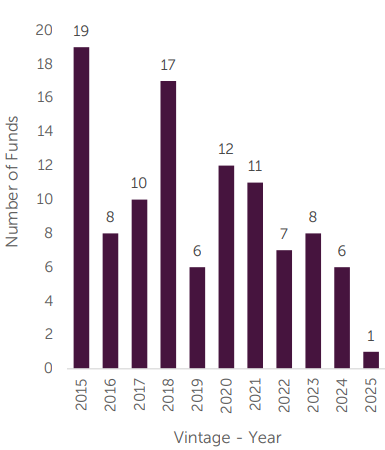
Figure 1: Number of Distressed Debt Funds Raised by Year, 2015 – YTD June 2025
Avg. Distressed Debt Fund Raised by Year (ii)
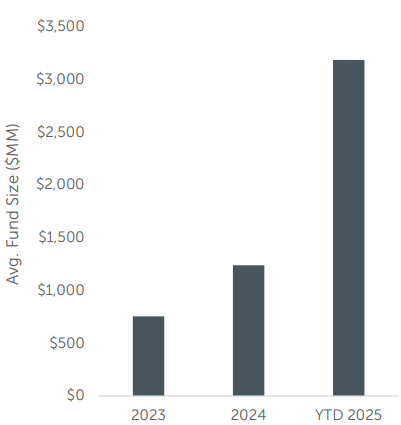
Figure 2: Average Size of Distressed Debt Funds Raised from 2023 – YTD June 2025
Potential Conflicts with Lending Strategies. Distressed investing often conflicts with large-scale capital deployment strategies such as Direct Lending. When a manager’s core business centers on originating direct lending deals, most of which finance financial sponsor-led leveraged buyouts, pursuing aggressive strategies to maximize returns in legacy distressed funds can antagonize or damage sponsor relationships. This, in turn, risks jeopardizing future lending deal flow, which is the very pipeline where recent AUM growth has occurred and where capital must be deployed promptly to begin generating fees. Given the heightened competition for allocations in direct lending transactions, in addition to providing debt on increasingly generous terms to win allocations, these asset managers are reluctant to reenter the distressed business despite the attractive opportunity because they are concerned about blowback to their larger, more scalable credit businesses.
Increasing Complexity. Structural changes in the credit markets have also added to the challenge for traditional distressed asset managers. Bankruptcy has become increasingly expensive and time consuming, limiting the desire for many credit managers to even consider investing in a potential in-court restructuring situation, with its resultant costs and unpredictable timelines. Other tools and technologies are utilized including out-of-court restructurings and Liability Management Exercises (LMEs), but require skill, experience and patience that make this investment strategy challenging for many institutional investors. In addition, as financial sponsors seek to have more control over who can own their debt (and therefore, with whom they negotiate), disqualified-lender lists (DQ Lists) have proliferated and sidelined much of Axar’s competition for investments—further narrowing the landscape of seasoned investors competing to buy distressed assets.
Simply put, the current diminished demand for investing in middle-market distressed debt often allows risk to transfer, or “clear the market,” at prices well below what fundamental value would dictate. This so-called “complexity premium” remains significantly higher in the middle market than in larger capital structures, driven by the scarcity of investors with the patience, mandate flexibility and specialized expertise to navigate such situations.
As always, distressed and event-driven investing demands patience, a tolerance for volatility, and the willingness and ability to own non-performing debt, which are qualities neither compatible with today’s incumbent owners of debt (i.e., CLOs) nor with the scaled approach now favored by the largest alternative asset managers. As a result, fewer competitors stand ready and willing to own, support, or put fresh capital into middle market distressed companies, creating an expansive and inefficient market for firms like Axar that have an opportunistic approach and patient mindset in the middle market.
In our third piece, we describe specifical structural factors in the Leveraged Loan market that, when combined with this competitive dynamic, cause risk to be consistently mispriced. These themes are not just transient anomalies, but we believe recurring features of the middle market where Axar operates, and where complexity, mispricing, and capital scarcity consistently create highly attractive opportunities for informed and highly selective capital.
DISCLOSURE
Axar Capital Management LP (“Axar”) has prepared this presentation (“Presentation”) for informational purposes only. This Presentation is not intended to constitute legal or tax advice and is not an investment recommendation.
This Presentation does not constitute an offer to sell or a solicitation of an offer to purchase any investment or any securities in an Axar-managed vehicle (a “Fund”). Such an offer can only be made at the time a qualified offeree receives the relevant offering documents which contains important information (including investment objectives, policies, risk factors, fees, tax implications and relevant qualifications), and only in those jurisdictions as permitted by law. Investment in a Fund is speculative and involves risk of loss. There can be no assurance that a Fund will achieve their investment objective. Investing involves a material risk of loss. Past performance is not indicative of future results.
While all the information contained in this Presentation is believed to be accurate, no guarantee, representation or warranty is made as to the accuracy, completeness or fairness of the information contained in this Presentation. Certain information in this Presentation reflects the current opinions of Axar which may prove to be incorrect and are subject to change. Certain information contained in this Presentation constitutes “forward-looking statements,” which can be identified by the use of forward-looking terminology such as “may,” “will,” “should,” “expect,” “anticipate,” “target,” “project,” “estimate,” “intend,” “continue,” or “believe” or the negatives thereof or other variations thereon or comparable terminology. Due to various risks and uncertainties, actual events or results may differ materially from those reflected or contemplated in such forward-looking statements.
END NOTES / SOURCES
(i) Pitchbook, includes funds raised between $200MM and $1.5BN with a similar strategy to Axar’s.
(ii) Pitchbook, all distressed debt funds raised by year.
Topics:
.png?width=2400&height=1257&name=73618-%20Axar-%20Blog%20%2310%20-%20derived%20from%20The%20Chopping%20Block%20-%20Feature%20Image%20(1).png)



.png?width=1200&height=628&name=Untitled%20design%20(18).png)








.jpg?width=360&height=203&name=imgi_13_648847-img_bars%20(1).jpg)