
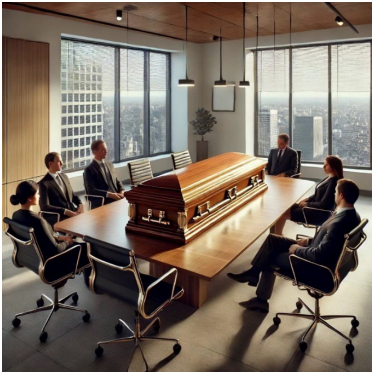
902 Broadway in New York’s Flatiron district was an unusual location for a creditors meeting, but then-CEO of SFX Entertainment Inc (“SFX”), Robert F.X. Sillerman, insisted on his office as the meeting place. The building entrance was ordained with a metal plaque that read “Bob’s Building”, which said it all. The group of four creditor firms, including Axar, met at reception and were escorted to the Company’s boardroom, where the four principals were surprised to see a coffin sitting on the table. “This is more crap, I’m leaving,” shouted one of the creditors, frustrated with a year-long ride in which SFX teetered on insolvency and toyed with creditors, but pulled several “rabbits out of the hat” to stay alive. SFX, however, was a distant memory from its celebrated NASDAQ IPO 3 years earlier, when Grammy award-winning DJ Afrojack rang the exchange’s closing bell. Just as tempers were about to boil over in that conference room, the lid of the coffin opened and Sillerman emerged from the box. Holding his permanent feeding tube in hand, he sat up and in his voice box-supported tone claimed, “It’s Not Over Yet.” Three weeks later, SFX filed Chapter 11 bankruptcy and Sillerman was removed from the Company shortly thereafter.
COMPANY BACKGROUND
SFX Entertainment Inc was the brainchild of Robert F.X. Sillerman and the third iteration of his media roll-up strategy under the same name. Beginning in 1996, in its first iteration, SFX was focused on consolidating live entertainment venues and concert promotion businesses, corporatizing the live music business for the first time. The platform acquired major promoters like Delsener/Slater, Bill Graham Presents, and PACE Entertainment, was sold to Clear Channel Communications in 2000 for over $4 billion and later spun out to become the basis for present-day Live Nation.
Sillerman relaunched SFX Entertainment in 2012, appearing on the cover of Billboard magazine with the headline, “Robert F.X. Sillerman has a $1 billion plan to conquer the world of dance music.” His vision was to roll up the dance music industry in both live events and digital content, making 15 acquisitions in three years including the crown jewels Beatport and ID&T/Tomorrowland. The company would go public in 2013 and reach over $1 billion of enterprise value. However, chronic mismanagement, outrageous corporate spending, and a hubris that Sillerman could do it all over again, left the business highly distressed by late 2015. Sillerman attempted to privatize the company in order to calm down creditors, in particular the artists, who were not receiving timely payments and entrepreneurs who had taken large amounts of SFX stock and/or cash earnouts as part of Sillerman’s acquisitions. By late 2015, the privatization had failed and Sillerman defaulted on his commitment to a last-ditch rescue loan. The Company’s $300 MM of secured debt, having been supported by false assumptions Sillerman had the resources to backstop the Company, collapsed below 40% of par by the end of 2015.
AXAR IDENTIFIES AN OPPORTUNITY
In SFX Entertainment, Axar saw an attractive collection of assets in the growing live events sector, all of which had been purchased in the prior few years, but never integrated and stricken by mismanagement, an onerous amount of debt, and wild corporate spending. Within the fifteen acquisitions that had been completed, Axar identified a small group of key assets where the majority of the value lay including Beatport, ID&T/Tomorrowland, Rock in Rio and Paylogic. The assets could be acquired cheaply through the secured debt before bankruptcy, and then through DIP Loans during the bankruptcy in 2016.
A core component of Axar’s thesis from the outset was the strategic interest in certain key assets. Moelis & Co. had attempted to sell the business a year earlier, but no buyer was willing to acquire all the assets, nor was there any interest in inheriting Sillerman’s mess (including substantial off-balance sheet liabilities).
A Chapter 11 filing was necessary, but in line with Axar's investment philosophy of always envisioning the exit at the point of entry, Axar engaged directly with select buyers for specific assets during the Chapter 11 process.
Those direct discussions with strategic buyers gave Axar the conviction to continue acquiring discounted DIP loans, as the underlying assets remained sound despite ongoing challenges with newly discovered liabilities at the corporate level and challenges exiting the bulk of the management team. For example, following Chapter 11, Rock in Rio was sold to Live Nation, a deal that was in negotiation during the bankruptcy process and reduced Axar’s cost basis by almost 40%.
In bankruptcy, the company eliminated its burdensome debt, fully deleveraging the balance sheet and eliminated significant off-balance-sheet liabilities including earn-outs, compensation guarantees and other “IOUs” that Sillerman had given over the three years of rapid expansion and acquisitions. Postbankruptcy, Axar’s plan was to sell off several assets, while improving the operations, management and performance of the two largest businesses, Beatport and ID&T. During the bankruptcy, Sillerman would step down as CEO (and entirely exit the Company), the business would be renamed LiveStyle and creditors would equitize over $400 MM of its debt, leaving Axar and another large institutional (par) holder as the company’s controlling shareholders. The path was now clear for Axar to focus on selling non-core assets to derisk its position while executing its plan to restore value to the crown jewel businesses that had significant upside.
BEATPORT EVOLVES
In October 2017, Robb McDaniels was hired as the new CEO of Beatport, a move that Axar was instrumental in effectuating. Robb had previously been the founder and CEO of Ingrooves, building the company into a global full-service distribution and artist services operation. Axar’s many years of experience has shown that getting the right CEO at a portfolio company is a critical step in improving company performance and unlocking value. Robb would help oversee several bolton acquisitions that would prove transformative for Beatport, as well as operational improvements that would grow revenue and EBITDA. These acquisitions broadened the offerings and services while deepening the platform’s customer relationships and brand. They included LabelRadar in 2023, a platform connecting artists with record labels; Loopmasters in 2020, a production tool for producers; Pulselocker in 2018, a streaming and storage technology platform for DJ’s; and Ampsuite in 2018, a white-label platform for music distribution.
Company Timeline:
-
2012 – Robert F.X. Sillerman relaunches SFX Entertainment, as a rollup of the dance music industry in live events and digital content
-
2013 – SFX goes public in a $260 MM NASDAQ IPO and reaches over a $1 billion enterprise value
-
2015 – Company begins to experience financial difficulties – failed privatization effort by Sillerman; Axar purchases secured debt ahead of Chapter 11
-
February 2016 – Company files for Chapter 11 Bankruptcy; Axar leads DIP loan process
-
December 2016 – Company emerges from bankruptcy, renamed LiveStyle; Axar converts loans to equity, gaining control of the company
-
2017-2018 – Non-core assets sold, including:
-
Tomorrowland sold to M&M (Management)
-
Rock in Rio sold to Live Nation
-
Paylogic sold Vivendi • 2017-2021 – Axar focuses on operational improvements and installs new CEOs at ID&T and Beatport; Axar acquires additional post-reorg equity as remaining funds reach liquidation, ultimately owning close to 100%
-
- Nov 2021 – ID&T sold to Providence Equity-backed SuperStruct Entertainment for over $150 MM in cash and equity
- 2024 – SuperStruct sold to KKR for €1.3BN, closing in November 2024 (Axar’s remaining interest is fully cashed out)
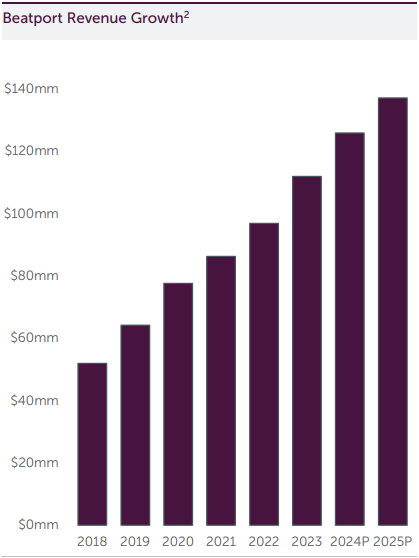
- 2025 – Beatport continues its strong growth, exceeding $100 MM of revenue (double 2018 revenue) and looking at monetization opportunities
AXAR DRIVING CHANGE AT ID&T
ID&T experienced increases in revenues and EBITDA from 2017 through 2019, via organic positive operational decisions/improvements and accretive bolt-on acquisitions. Revenue grew in G13 markets and other live events by offering additional days, expanding camping and weekend offerings, increasing ticket prices and maximizing event attendance. They also accelerated revenues and gross profits through attractive non-live revenue streams, including merchandise, agencies and sponsorships, which further diversified revenue streams at attractive margins. Lastly, management implemented several permanent cost-saving measures during Covid-19 to support bottom-line growth. All of this led to revenues growing from €123.4mm in 2017 to €136.9mm by 2019, while EBITDA increased from €12.7mm to €14.5mm. Key bolt-on acquisitions also occurred during this pivotal time, including acquiring Art of Dance, the largest competitor in the market.
Crucially, Axar brought back the old management team (a playbook run several times in the past), including hiring Wouter Tavecchio as CEO. Wouter was a Founder of Q-Dance, ID&T’s most valuable subsidiary and had been with the group for 15+ years prior to disputes with Sillerman in 2015 that resulted in Wouter stepping down as CEO. The newly installed (old) leadership team had deep relationships with key stakeholders, including artists, venues, local government, suppliers, and sponsors. To accelerate growth, the team empowered the founders and early partners of the major brands that comprised ID&T group.
As the team was feeling increasingly confident in the turnaround and preparing for sale, a curveball came that seemed to threaten the very concept of the live events business.
ID&T SALE/SUPERSTRUCT TRANSACTION
ID&T continued to see growth under Axar leadership through 2019, and then Covid hit in 2020, putting a screeching halt to live event/music promotion. For 2020, revenue plummeted 88% to €16.5mm as live events were all but shut down. Despite difficult odds, ID&T was successfully sold to SuperStruct Entertainment (“SSE”) during the height of the pandemic at an attractive valuation, for a cash payment and a minority interest in SuperStruct. Both companies were “all-in” on a reopening of live events, so it made strategic sense to use the downtime to integrate ID&T into the SSE platform. SuperStruct is a leading global live events owner and operator of over 80 music festivals across 10 countries in Europe and Australia. SuperStruct was ultimately sold to KKR for €1.3BN, closing in November 2024, resulting in a large distribution to Axar and reaching over 100% DPI 1 on the LiveStyle investment (while retaining full ownership of The Beatport Group).
BEATPORT: A BRIGHT FUTURE
Given Beatport’s solid management team, strong growth and bright prospects, we are looking to monetize this investment. Once completed, we will have fully liquidated the LiveStyle investment. We are canvassing an array of strategic buyers and financial sponsors to purchase a partial or full position in Beatport. There are several strategic buyers for whom the assets of Beatport would be complementary to their offerings and services. We expect to sell this investment sometime in the first half of 2025 and, based on our investment thesis, we see potential for meaningful value realization. This would mark the completion of the full arc—breathing life into the LiveStyle coffin left for dead—fulfilling Sillerman’s vision with Axar’s skilled and guiding hand, and ultimately unearthing substantial value for Axar’s partners.
DISCLOSURE
Axar Capital Management LP (“Axar”) has prepared this confidential presentation (“presentation”) for informational purposes only.
The case study included in this presentation was selected based on objective, non-performance-based criteria, namely that such portfolio company, in Axar’s opinion, is illustrative of Axar’s investment philosophy. The company identified does not represent all of the securities purchased, sold, or recommended by Axar.
Certain information contained in this presentation constitutes “forward-looking statements,” which can be identified by the use of forward-looking terminology such as “may,” “will,” “should,” “expect,” “anticipate,” “target,” “project,” “estimate,” “intend,” “continue,” or “believe” or the negatives thereof or other variations thereon or comparable terminology. Due to various risks and uncertainties, actual events or results may differ materially from those reflected or contemplated in such forward-looking statements. There is no guarantee Axar will be successful in achieving its objectives. Past performance is not indicative of future results.
While all the information contained in this presentation is believed to be accurate, no guarantee, representation or warranty is made as to the accuracy, completeness or fairness of the information contained in this document. Projected financial information and other forward-looking statements do not, nor are they intended to, constitute a promise of actual results. Such information and forward-looking statements involve known and unknown risks, uncertainties and other important factors that could cause actual results, performance, achievements or industry results to differ materially from the financial information, projections and estimates included in this presentation.
Certain information contained in this presentation is non-public, proprietary, and highly confidential and is provided to selected recipients only on a confidential basis. Accordingly, by accepting this presentation, the recipient acknowledges and agrees that it will maintain the information and data contained herein in the strictest of confidence and will not reproduce this presentation or disclose any of the contents hereof to any other person unless permitted by Axar.
This document is not intended to constitute legal or tax advice and is not an investment recommendation.
End Notes
1 DPI is net of fees and expenses
2 Source: Beatport Company Financials
Topics:
.png?width=2400&height=1257&name=73618-%20Axar-%20Blog%20%2310%20-%20derived%20from%20The%20Chopping%20Block%20-%20Feature%20Image%20(1).png)


.png?width=1200&height=628&name=Untitled%20design%20(18).png)








.jpg?width=360&height=203&name=imgi_13_648847-img_bars%20(1).jpg)