---
title: "Active vs. Passive in Distressed Credit: Why Showing Up at the Table Changes the Outcome"
description: In distressed credit, passive and active are not equivalent strategies. Learn why creditor engagement matters in middle-market restructurings and what active involvement can actually look like in practice.
image: https://insights.axarcapital.com/hubfs/68651-%20Axar-%20Blog%206-%20Active%20vs.%20Passive%20Feature%20Image.png
---
[Skip to main content](https://insights.axarcapital.com/active-vs-passive-distressed-credit#maincontent)
- [Home](https://axarcapital.com/)
- [About](https://axarcapital.com/about)
- [Our Values](https://axarcapital.com/our-values)
- [Approach](https://axarcapital.com/approach)
- [Team](https://axarcapital.com/team)
- [Careers](https://axarcapital.com/careers)
- [News & Insights](https://insights.axarcapital.com/)
- [Contact](https://axarcapital.com/contact)
- [Login](https://access.hedgeserv.com/wauth/login)
[« View All Posts](https://insights.axarcapital.com)
# Active vs. Passive in Distressed Credit: Why Showing Up at the Table Changes the Outcome
June 18th, 2026
8 min read
By [Axar Capital Management LP](https://insights.axarcapital.com/author/axar-capital-management-lp)

Consider a scenario where a middle market company tips into distress. The capital structure is contested, the management team is part of the problem, and the business has real value underneath a bad balance sheet. The largest lender, a CLO with 28% of the loan, begins selling within the week. The second largest, a mutual fund, follows. By the time anyone with the mandate to actually engage shows up, the terms of the restructuring have already been set.
That sequence plays out more often than it should. And it points to something the active vs. passive debate in credit rarely examines directly: in distressed situations, passive and active are not equivalent strategies. Who shows up, what they bring, and how involved they're willing to get can materially shape what happens next.
This distinction rarely gets examined carefully. Most discussions about active vs. passive management focus on equities, where the debate centers on stock selection and fee drag. In credit, particularly distressed credit, the question is different. It's not about picking winners from the sidelines. It's about whether you can change what the outcome actually is.
### Why Distressed Situations Are Different
Performing credit is fairly linear. The company earns cash, services its debt, and eventually repays. The creditor's role is largely administrative. You get paid or you don't, but there isn't much you can do to influence which.
Distressed credit doesn't work that way. A company under financial stress faces a genuine fork in the road. The capital structure may need to be renegotiated. Management may need to be replaced. Operations may need to be restructured. Non-core assets may need to be sold. These decisions don't make themselves, and the people who get a seat at the table often have significant influence over which path gets taken.
The outcome is not predetermined. Creditor engagement can influence it.
In many middle market restructurings, the difference between a company that successfully restructures and one that liquidates comes down to whether someone with operational expertise and real capital commitment is willing to engage. That engagement rarely happens on its own.
### What Passive Holders Typically Do in Stress
The largest holders of corporate credit in the U.S. are CLOs, mutual funds, and ETFs. CLOs alone own roughly 75% of the leveraged loan market. And in a stress event, most of them are structurally limited in what they can do.
CLO indentures typically prohibit managers from taking board seats or serving on creditor committees. The governance restrictions are intentional; the vehicles are designed for diversified credit exposure, not active stewardship of individual positions. The constraint goes deeper than the indenture language, too. When overcollateralization tests start to fail, the manager's incentive structure flips entirely, and selling the distressed credit at whatever price clears the market becomes the rational move, a dynamic examined in depth in a [prior piece on CLO pricing mechanics](https://insights.axarcapital.com/clo-overcollateralization-leveraged-loan-pricing-anomalies). That's not a failure of judgment. That's the vehicle working exactly as designed.
Mutual funds and ETFs face a different version of the same problem. They have redemption obligations. A protracted restructuring that requires active oversight and a multi-year hold period is a poor fit for a vehicle that might need to return capital on 24 hours' notice. The time horizon mismatch isn't a flaw; it's a structural feature of what those vehicles are built to do.
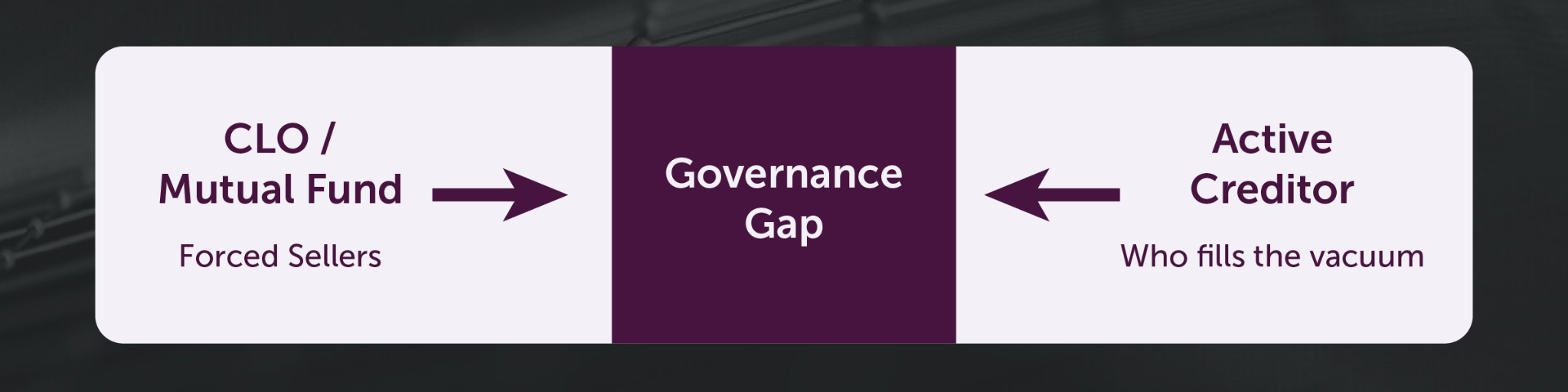
The result: when a middle market company tips into distress, the largest nominal holders of its debt are often simultaneously the most motivated sellers and the least able to influence what happens next. They show up in the cap table but not at the table.
### **The Governance Gap**
This creates what might be called a governance gap. There's often no single creditor with both the size and the mandate to push for operational improvement. The CLO that owns 30% of the loan is a forced seller. The smaller specialist funds that might engage are individually too small to drive outcomes. The company's fate gets negotiated between creditors focused primarily on their own recovery rates and management teams that may have contributed to the problem in the first place.
This isn't a criticism of any individual party. It's an accurate description of how many restructurings actually unfold, and it's a structural feature of how corporate credit is owned today, not a temporary condition.
Consider what that gap means in practice. A company hitting a stress event may have a viable business underneath the bad balance sheet. The assets are real. The customer relationships exist. The brand has value. What's broken is the capital structure and, in some cases, the management team. Neither of those problems is inherently fatal. But fixing them requires someone with the mandate, the expertise, and the time horizon to actually try.
When that creditor doesn't exist, or shows up too late, or is structurally prevented from engaging, the company often gets liquidated or restructured on terms that destroy value that didn't need to be destroyed. The governance gap is where recoveries go to die.
An engaged creditor with operational resources changes that dynamic. Not because they can dictate outcomes, but because they can bring something to the table that purely financial participants typically cannot: the ability to assess whether the business has real value, identify what's needed to capture it, and then actually help execute the changes required.
### **What Active Involvement Can Look Like in Practice**
Active involvement in distressed credit is not a uniform strategy; the appropriate level of engagement depends heavily on the situation. But across a range of middle market restructurings, several forms of active participation tend to be where creditors can have genuine influence.
Creditor committee participation. In Chapter 11 proceedings, official and ad hoc creditor committees have real power over plan confirmation and the terms of any reorganization. Creditors who engage in that process, rather than passively waiting for a plan to be filed, often get materially better outcomes on covenant packages, governance rights, and exit valuation.
Board participation. Post-restructuring, a creditor who takes a board seat has ongoing visibility into operations and strategic decisions. This is particularly meaningful in businesses where the turnaround thesis depends on specific operational changes being made and sustained over time. A board seat is not a guarantee of influence, but it is a prerequisite for it.
Management recruitment. One of the most consequential decisions in any restructuring is whether the incumbent management team is the right one to execute the recovery. An engaged creditor with a genuine network of operators can identify and recruit replacement management, which in many cases is the single highest-leverage action available. The financial engineering matters less than who's running the business on the other side of the restructuring.
Operational input. In businesses where the operational issues are as significant as the financial ones, a creditor with sector expertise can provide input that purely financial advisors cannot. This might mean working through a go-to-market strategy, a cost structure, or an approach to non-core asset divestitures. The creditor isn't running the company. They're helping identify what needs to change and making sure the right people are in place to change it.
To be clear: active involvement is not the same as operational control. The goal is not to run the company. It's to create conditions where the right people are running it, with the right resources and the right mandate, and to stay close enough to the situation to course-correct when needed.
Axar has applied this approach across a number of middle market situations, including Everstory Partners and J.G. Wentworth. \*References to specific investments are provided for illustrative purposes only and do not represent all investments made by the Firm. Past performance is not indicative of future results. In both cases, active involvement meant board participation, leadership changes, and operational input on strategic priorities, not passive observation from the cap table while someone else decided what happened next.
### The Time Dimension
Active distressed investing requires patient capital. That's not a euphemism for a slow return profile; it's a structural feature of the strategy. A creditor that needs liquidity cannot take a board seat, cannot commit to a multi-year operational improvement plan, and cannot build the concentrated positions that make active involvement worth the effort.
The tradeoff is real. Patient capital has an opportunity cost. Locked-up capital cannot rotate quickly into new situations. These are legitimate constraints that institutional allocators think carefully about, and they should.
But the flip side is also true. An investor constrained to shorter holding periods and higher liquidity requirements is, by definition, an investor who can react to outcomes but cannot shape them. The potential to influence outcomes is one of the key features of patient capital.
Time arbitrage, building positions over 18 to 24 months, increasing exposure as the risk picture clarifies, and staying in position through the operational improvement phase, requires a fund structure aligned with that hold period. It cannot be layered onto a vehicle designed for something else. The CLO that is forced to sell at 60 cents because its OC test is failing and the distressed specialist that buys at 60 cents are not in the same business. They happen to own the same instrument.

### The Broader Argument
The passive vs. active debate in distressed credit ultimately comes down to a question about where value gets created and captured.
CLOs and mutual funds are not poorly managed. They are doing exactly what they are built to do. The governance gap isn't caused by bad actors; it's caused by a market structure where the largest holders of distressed credit are structurally prevented from behaving like owners. That structure isn't going to change. The incentives that make CLOs sell into distress are the same incentives that make them attractive vehicles for credit exposure in the first place.
That persistent structural feature is what creates the opportunity for a different kind of investor. Not one that is simply willing to hold longer, but one that is actually set up to engage: with the mandate, the operational capacity, and the capital structure to show up when it matters.
Most of the time, in most credit investments, passive exposure is the right call. But in situations where the outcome is genuinely in play, the difference between someone who shows up and someone who doesn't may be the difference between a recovery and a loss.
Download Credit Unbound to see how Axar applies this philosophy across the middle market credit cycle.
#### [](https://insights.axarcapital.com/hs/cta/wi/redirect?encryptedPayload=AVxigLIZKEB4K2IQsVVAK6kcajDhkLRg8AHaDV%2F981kcqJchjfrLqWufKO7eD9iH2%2FT2A09DKvgaSlyENj7pL05f9Wrwpg%2BGR%2FG4bv3H0ukr7YANOGAS7qfSX0Lur2oAKpbGL1f%2BiMG1Sp3DJ6j23AkC2byhSZyPPlTv0ATgLuQBaeFbW%2FpUv7NLdyjpd62q86oNetiIIvXNLLNPkzefQLEqX9MgKEfBJhQQjXRkYAm%2FKlhwnRswDU61U7v4QqkfTQKMPM7HHCyDoVhfq8zCzkgzBQ%3D%3D&webInteractiveContentId=209805073440&portalId=49721052)
This material is provided for informational purposes only and does not constitute an offer to sell or a solicitation of an offer to buy any securities or investment advisory services. The views expressed herein are those of Axar Capital as of the date of publication and are subject to change without notice.
This material is not intended to provide, and should not be relied upon for, investment, legal, or tax advice. Any forward-looking statements or discussions of potential outcomes are based on current expectations and assumptions and are subject to change. There can be no assurance that any investment strategy will be successful or that any outcomes discussed herein will be achieved. References to specific investments are provided for illustrative purposes only and do not represent all investments made by Axar Capital. Past performance is not indicative of future results.
### FAQ Section
Why can't CLOs just engage in restructurings like other creditors?
CLO indentures typically prohibit managers from taking governance roles such as board seats or creditor committee positions. Beyond the legal restriction, when a CLO breaches its overcollateralization tests, the manager's incentive structure shifts entirely toward selling and restoring compliance, not toward patient engagement with a distressed borrower. The vehicle is designed for diversified credit exposure, not active stewardship of individual positions.
What is the governance gap in middle market restructurings?
The governance gap refers to the absence of a creditor with both the size and the mandate to actively influence the outcome of a restructuring. The largest holders are typically CLOs or mutual funds that are structurally constrained from engaging. Smaller specialist funds may lack the position size to drive outcomes alone. The result is that many middle market restructurings proceed without any creditor taking meaningful responsibility for the operational decisions that determine whether the business survives.
What does active involvement in distressed credit actually look like?
Active involvement can take several forms depending on the situation: participation on official or ad hoc creditor committees, post-restructuring board representation, recruiting replacement management, and providing operational input on strategy, cost structure, or asset divestitures. The goal is not to run the business but to create conditions where the right people are running it and to stay close enough to course-correct when needed.
Why does active distressed investing require patient capital?
Building a position of sufficient size to have genuine influence, taking a board seat, and supporting a multi-year operational turnaround all require a fund structure with a hold period aligned to those activities. A vehicle with redemption obligations or a short investment horizon cannot make those commitments. The tradeoff is real: patient capital has an opportunity cost. But an investor who cannot commit cannot shape the outcome, only react to it.
Is active involvement in distressed credit a guarantee of better outcomes?
No. Active involvement increases the probability that value-creating decisions get made and implemented, but it does not guarantee results. Not every business has recoverable value underneath the bad balance sheet. External factors, market conditions, and management execution all matter. The case for active involvement is that it gives a creditor the ability to influence the variables that are within reach, which passive participation does not.
#### About Axar Capital Management
Axar Capital Management LP is a $3.3 billion opportunistic investment manager focused on U.S. middle market companies with $200 million to $800 million in debt outstanding. Founded in 2015 and 100% employee-owned, Axar specializes in complex situations where traditional institutional capital operates inefficiently. The firm is headquartered at 402 W 13th Street, New York, NY.
**Disclaimer:** Axar Capital Management LP ("Axar") has prepared this content for informational purposes only. This content is not intended to constitute legal, tax, financial, or investment advice. While all information contained herein is believed to be accurate, no guarantee, representation or warranty is made as to its accuracy, completeness or fairness. Certain information reflects the current opinions of Axar which may prove to be incorrect and are subject to change. Past performance is not indicative of future results. Investing involves a material risk of loss. Certain statements herein reflect forward-looking views, which are inherently uncertain and subject to change. Actual results may differ materially.
Topics:
[Insights](https://insights.axarcapital.com/topic/insights)
Don't forget to share this post:
## Related Articles
### [.png?width=2400&height=1257&name=73618-%20Axar-%20Blog%20%2310%20-%20derived%20from%20The%20Chopping%20Block%20-%20Feature%20Image%20(1).png) The Nucleus: Why a Failed Balance Sheet Doesn’t Mean a Failed Business September 24th, 2026|8 min read](https://insights.axarcapital.com/the-nucleus-why-a-failed-balance-sheet-doesnt-mean-a-failed-business)
### [ The AI Value Gap August 21st, 2026|8 min read](https://insights.axarcapital.com/the-ai-value-gap)
### [ Switching Costs, The Moat Customers Don't Notice They're Trapped By August 19th, 2026|8 min read](https://insights.axarcapital.com/switching-costs-the-moat-customers-dont-notice)
### [ The Compounders Built on Overlooked Balance Sheets August 5th, 2026|8 min read](https://insights.axarcapital.com/compounders-built-on-overlooked-balance-sheets)
### [.png?width=1200&height=628&name=Untitled%20design%20(18).png) 2026 2H Market Outlook – the “Velvet Rope Market” July 9th, 2026|8 min read](https://insights.axarcapital.com/2026-2h-market-outlook-velvet-rope-market)
### [ The PE Overhang: Why Sponsors Are Stuck and What It Means for Credit June 3rd, 2026|8 min read](https://insights.axarcapital.com/private-equity-overhang-dpi-credit-markets)
### [ What Happens to a Company After a Liability Management Exercise May 20th, 2026|8 min read](https://insights.axarcapital.com/what-happens-after-liability-management-exercise)
### [ CLOs Own 75% of the Leveraged Loan Market. Here's Why That Creates Pricing Anomalies. May 6th, 2026|8 min read](https://insights.axarcapital.com/clo-overcollateralization-leveraged-loan-pricing-anomalies)
### [ The Chopping Block: The Anatomy of a Great Distressed Investment April 24th, 2026|8 min read](https://insights.axarcapital.com/the-chopping-block-the-anatomy-of-a-great-distressed-investment)
### [ The Lenders Who Left: How a Decade of Easy Money Quietly Reshaped the Distressed Credit Landscape April 22nd, 2026|8 min read](https://insights.axarcapital.com/the-lenders-who-left-distressed-credit-landscape)
### [ Credit Quality in Decline — Why the Middle Market Is Axar's Hunting Ground April 10th, 2026|8 min read](https://insights.axarcapital.com/credit-quality-in-decline)
### [ From Grave Concerns to Growth: The Everstory Revival March 30th, 2026|8 min read](https://insights.axarcapital.com/from-grave-concerns-to-growth-the-everstory-revival)
### [.jpg?width=360&height=203&name=imgi_13_648847-img_bars%20(1).jpg) 2026 Market Outlook January 19th, 2026|8 min read](https://insights.axarcapital.com/2026-market-outlook)
### [ The Chopping Block: Building Culture- How Two CEOs Turned Distress into Durable Growth November 11th, 2025|8 min read](https://insights.axarcapital.com/the-chopping-block-building-culture-how-two-ceos-turned-distress-into-durable-growth)
### [ Credit Unbound IV: Capitalizing on a Shifting Opportunity Set October 27th, 2025|8 min read](https://insights.axarcapital.com/credit-unbound-part-4)
### [ Credit Unbound III: Capitalizing on a Shifting Opportunity Set September 15th, 2025|8 min read](https://insights.axarcapital.com/credit-unbound-part-3)
### [ Credit Unbound II: Capitalizing on a Shifting Opportunity Set September 8th, 2025|8 min read](https://insights.axarcapital.com/credit-unbound-part-2)
### [ Credit Unbound I: Capitalizing on a Shifting Opportunity Set September 1st, 2025|8 min read](https://insights.axarcapital.com/credit-unbound-part-1)
### [ The Chopping Block: Chipping Away at the LME Opportunity June 20th, 2025|8 min read](https://insights.axarcapital.com/the-chopping-block)
### [ When The Music Stops March 3rd, 2025|8 min read](https://insights.axarcapital.com/when-the-music-stops)
### [ Cashing In On Cash Now October 15th, 2024|8 min read](https://insights.axarcapital.com/cashing-in-on-cash-now)
### [ Jailbreaking Value July 1st, 2024|8 min read](https://insights.axarcapital.com/jailbreaking-value)
- [Home](https://axarcapital.com/)
- [About](https://axarcapital.com/about)
- [Our Values](https://axarcapital.com/our-values)
- [Approach](https://axarcapital.com/approach)
- [Team](https://axarcapital.com/team)
- [Careers](https://axarcapital.com/careers)
- [News & Insights](https://insights.axarcapital.com/)
- [Contact](https://axarcapital.com/contact)
- [Login](https://access.hedgeserv.com/wauth/login)
© 2026 Axar Capital Management LP. All Rights Reserved.
Privacy Policy. Terms Of Service.
```json
{
"@context" : "https://schema.org",
"@type" : "BlogPosting",
"author" : {
"@type" : "Person",
"name" : "Axar Capital Management LP",
"url" : "https://insights.axarcapital.com/author/axar-capital-management-lp"
},
"dateModified" : "2026-06-25T15:12:32.830Z",
"datePublished" : "2026-06-18T18:47:45.000Z",
"headline" : "Active vs. Passive in Distressed Credit: Why Showing Up at the Table Changes the Outcome",
"image" : [ "https://insights.axarcapital.com/hubfs/68651-%20Axar-%20Blog%206-%20Active%20vs.%20Passive%20Feature%20Image.png" ],
"mainEntityOfPage" : {
"@id" : "https://insights.axarcapital.com/active-vs-passive-distressed-credit",
"@type" : "WebPage"
},
"publisher" : {
"@type" : "Organization",
"logo" : {
"@type" : "ImageObject",
"url" : "https://insights.axarcapital.com/hubfs/Logo/Axar_logo.png"
}
}
}
```