---
title: 2026 Market Outlook
description: Explore the 2026 market outlook as Axar Capital Management analyzes the shifting landscape of corporate credit, revealing investment opportunities amid rising stress.
image: https://insights.axarcapital.com/hubfs/imgi_13_648847-img_bars%20(1).jpg
---
[Skip to main content](https://insights.axarcapital.com/2026-market-outlook#maincontent)
- [Home](https://axarcapital.com/)
- [About](https://axarcapital.com/about)
- [Our Values](https://axarcapital.com/our-values)
- [Approach](https://axarcapital.com/approach)
- [Team](https://axarcapital.com/team)
- [Careers](https://axarcapital.com/careers)
- [News & Insights](https://insights.axarcapital.com/)
- [Contact](https://axarcapital.com/contact)
- [Login](https://access.hedgeserv.com/wauth/login)
[« View All Posts](https://insights.axarcapital.com)
# 2026 Market Outlook
January 19th, 2026
9 min read
By [Axar Capital Management LP](https://insights.axarcapital.com/author/axar-capital-management-lp)
.jpg?width=360&height=203&name=imgi_13_648847-img_bars%20(1).jpg)
2025 looked like a benign year for risk assets. Equity indices finished strong, setting many records along the way, and credit spreads remained historically tight. Moreover, financial conditions, by most headline measures, appeared solid. Yet from where we sit, in the middle-market corporate credit ecosystem dominated by sponsor-backed companies, volatility was not absent. It was simply unevenly distributed.
Over the course of the year, a begrudging recognition began to take hold: underwriting risk in certain situations had been materially underestimated. That realization was catalyzed by the high-profile failures of Tricolor and First Brands, situations where sophisticated credit investors missed what, in hindsight, were glaring red flags. These episodes did not meaningfully disrupt index-level pricing and spreads, but they did expose vulnerabilities that were not reflected in reported default rates or headline credit performance.
### Dispersion Beneath the Surface
While headlines were dominated by AI enthusiasm, the Mag 7, and the Taylor Swift / Travis Kelce engagement, dispersion in leveraged credit markets quietly accelerated to levels not seen since 2009. The universe of distressed debt expanded meaningfully throughout 2025. Loans trading below 80 cents increased sharply over the past two years, the sub-70 cohort reached a 31-month high in December, and performance dispersion widened dramatically. The return gap between distressed credit and performing loans reached approximately 25 percentage points in 2025 i.
Periodic risk-off episodes, driven by spring tariff headlines and headline-grabbing bankruptcies later in the year, briefly interrupted market euphoria. But the persistent need to remain invested and “clip yield” ultimately overwhelmed investor concerns about historically tight credit spreads, poor underwriting discipline, or latent systemic risk. In short, while volatility flared episodically, calm prevailed at the index level. Meanwhile, stress quietly compounded in precisely those pockets of the market that matter most to Axar.
### The Middle Market as the Fault Line
This bifurcation in corporate America mirrors what we observe in the consumer economy. A narrow cohort of consumers, roughly the top 1%, has benefited disproportionately from strong job growth and asset price appreciation in recent years, while a majority of consumers face mounting financial strain. In 2025, the Federal Reserve reported that approximately 40% of U.S. consumers could not absorb a sudden $400 expense.
We see the same dynamic playing out in corporate credit. Large-cap companies continue to enjoy abundant access to capital and robust equity price performance. While the S&P 500 gained approximately 18% in 2025, returns were heavily concentrated among a handful of mega-cap names, which contributed to 54% of the overall index gains, with the Mag 7 gaining 24% unweighted and the S&P 493 gaining significantly less. By contrast, the Russell 2000 gained only 13%, reflecting relative weakness among smaller businesses (particularly those with levered balance sheets).
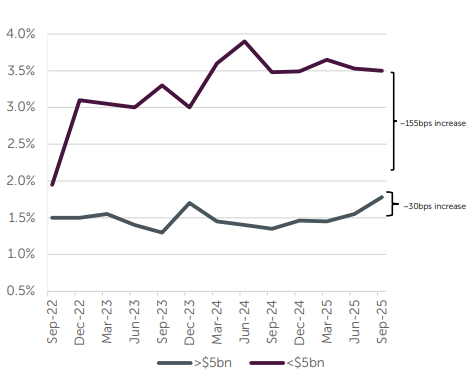
Relatedly, as the chart below shows, stress is showing up more clearly in the smaller BDC cohort—firms whose portfolios skew toward middle-market loans— while larger BDCs, with broader scale and more diversified exposure, have so far been comparatively insulated. According to Moody’s, the adjusted default rate for middle-market corporate term loans approached 9% in 2025, the highest level since 2009. Once again, dispersion, not broad-based distress, is the defining characteristic of the current environment.
#### Non-Accruals as % of Portfolio by BDC by Size ii
---
### Private Equity Pressure and the Limits of Financial Engineering
We believe the weakness in middle-market credits, combined with the evolution and dramatic growth of private credit markets over the last decade, has set the stage for a multi-year opportunity in opportunistic credit beginning in 2026.
During the 2020–2022 boom period, approximately 70% of all private equity transactions, nearly 10,000 deals, occurred in the middle market iii. Fast forward five years and more than half of private equity–backed businesses have been held for over five years iv. Amid record equity markets and historically tight credit spreads, private equity capital return and exit activity remains weak, with private equity DPI in 2025 estimated at roughly 10%, v the lowest level since 2009 and well below the long-term average of 33%.
At the same time, liability management exercises (LMEs) emerged as the primary tool for extending duration and deferring restructurings. Nearly half of middle-market adjusted defaults in 2025 involved some form of LME vi. While these transactions do extend time for sponsors, their capacity to create a successful refinancing or private equity exit is still in doubt and highly unlikely for many of the companies that participated in these exchanges. According to a study by a large New York-based law firm, of the post-LME sponsor-backed companies that had reached maturity, nearly 80% restructured with the creditors taking control of the equity. The ability to execute successive LMEs, as described later in this letter, is also very limited so options ahead of liquidity shortages and/or looming maturities become very scarce.
Private equity limited partners want liquidity. Post-LME maturities are rapidly approaching starting in 2026. The clock is ticking.
### Enter 2026
We believe that this disconnect between what the headlines appear to be signaling and what is unfolding at the company and capital-structure level sets the stage for 2026. Stress that has been deferred, obscured, or engineered around is increasingly likely to surface now through more traditional channels: restructurings, forced asset sales, ownership and control transitions, and complex capital solutions.
### Axar’s Approach
Axar does not focus on macro forecasting. We do not possess a durable edge in predicting interest rates, elections, or geopolitics, nor do we predicate investments on variables beyond our control. Instead, our focus remains on what we can control: preparation, underwriting rigor, and disciplined engagement and influence over individual situations.
Our process, refined over more than a decade at Axar, centers on operating within four core sectors we know deeply, conducting comprehensive bottom-up analysis, scrutinizing credit documentation, and staying closely engaged with advisors, management teams, counterparties, and fellow investors. As complexity and volatility rise, experience, pattern recognition, and judgment become increasingly critical.
That is where our focus and experience reside. And that is where we believe the 2026 opportunity set is forming.
Outlined below are three key themes we believe will drive outcomes and returns in 2026 and guide how Axar allocates its origination and underwriting resources.
### Executive Summary of the Key Themes in 2026:
1. Capital remains open and competitive for high-quality issuers, and we expect to use this window proactively for existing portfolio companies (exits and refinancings).
2. Liability management tools are approaching their limits for many borrowers, which should lead to more hard defaults and comprehensive restructurings.
3. Direct Lending is being pulled into the open, with growing secondary activity and liquidity needs creating a larger and more accessible universe for opportunistic capital.
### Theme 1: Capital Is Abundant, But Conditional
As we enter 2026, it is important to set the stage clearly: capital markets remain open for business. Corporate credit spreads are near historical tights, currently at the 99 percentile vii, and capital is widely available for issuers that fit the market’s preferred profile. For higher-quality borrowers with clean narratives and acceptable ratings, financing conditions remain highly competitive.
That said, access to capital has become increasingly selective. Market receptivity has narrowed while many sponsor-backed companies, particularly those that have pursued LMEs, remain effectively shut out of conventional refinancing markets. This is not a market starved for capital deployment; it is a market that is increasingly discerning.
### Demand for IG Corporate and Structured Credit is Strong
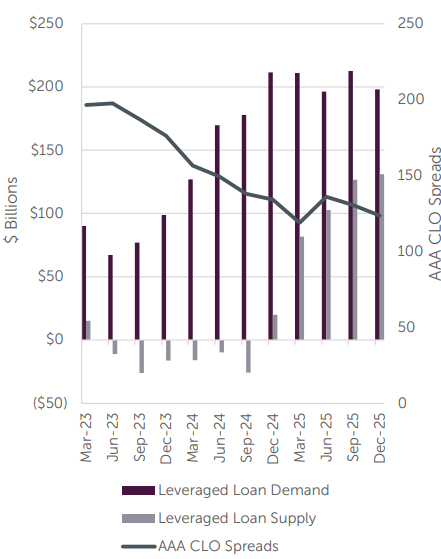
Structural demand continues to underpin senior credit. CLO AAA tranches remain compelling on a relative-value basis for banks, anchoring senior spreads and sustaining securitization activity. As a result, broadly syndicated loans should continue to serve as an attractive and reliable source of capital for qualifying issuers.
Even as base rates are likely to move modestly lower, all-in loan yields remain palatable for investors, supporting continued inflows into the asset class. The result is a bifurcated market: ample capital for those who meet narrowing criteria, and fewer options for those who do not—conditions that historically create opportunity for flexible, opportunistic credit providers.
#### Leveraged Loan Supply/Demand vs. AAA CLO Spreads viii
#### 
### Implications for Axar’s Investors:
Where capital markets remain open and functional, we will act opportunistically to optimize existing debt and equity positions, refinancing on improved terms, strengthening documentation, and reducing risk. We are always on the lookout for exit opportunities.
New investment opportunities will be focused on borrowers unable to access conventional markets on acceptable terms, where complexity, illiquidity, and capital scarcity can create compelling risk-adjusted opportunities.
## Theme 2: Less “Kicking the Can,” More Forced Outcomes
If 2024 and 2025 were defined by Liability Management Exercises (“LMEs”) and maturity extensions, 2026 is likely to mark the transition to the next chapter. While LME activity will continue (it is now a common feature of the credit markets; the technology is here to stay, though will continue to evolve), many of the transactions executed over the past several years are now confronting additional liquidity needs and fixed maturity walls that can’t be further extended.
This is because earlier LMEs often consumed remaining flexibility, shrinking or eliminating basket capacity, tightening documentation, and raising voting thresholds for credit agreement amendments. As a result, additional extensions are often prohibitively difficult to execute. In practice, sponsors typically have one opportunity to pursue a solution without providing additional equity capital. Thereafter, direct sponsor equity is required, or the company typically faces a restructuring. Many middle-market companies will be at this crossroad in 2026.
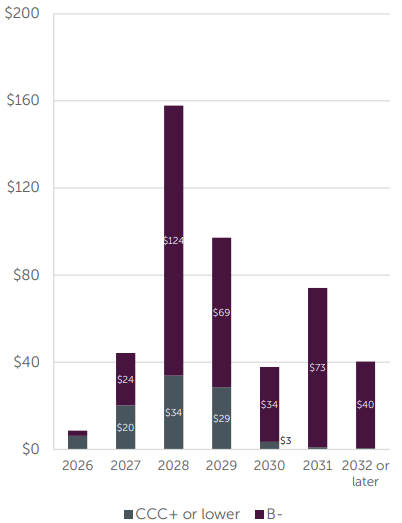
As these capital structures with limited flexibility move closer to maturity, we expect a higher incidence of hard defaults and comprehensive restructurings, especially within the broadly syndicated loan market. We estimate that hundreds of issuers, representing more than $150bn+ of debt, face this convergence.
#### Looming Maturity Wall, B- and Lower ($ Billions) ix
### Implications for Axar’s Investors:
We expect the volume of actionable stressed and distressed situations to increase over the coming years. Axar is positioned to participate by building exposure early, underwriting capital structures and documentation rigorously, and increasing commitments as temporary solutions give way to durable outcomes.
## Theme 3: Direct Lending Steps Out of the Shadows
Direct Lending has grown rapidly over the past fifteen years, expanding from a marginal market in 2010 to nearly $2 trillion by 2025 x. Much of this growth occurred in an environment characterized by low rates, limited defaults, and mark-to-model valuation practices that muted observed volatility. Direct lending played a central role in financing the 2020–2022 private equity boom and now represents a large, illiquid segment of the corporate credit landscape.
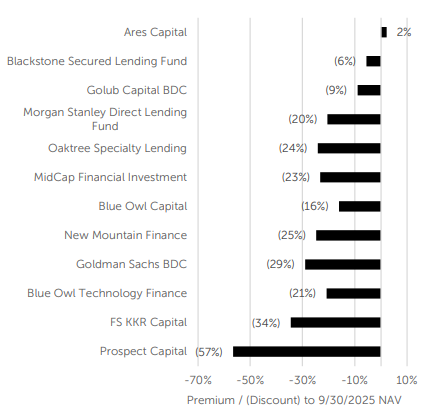
Several indicators suggest that this market is entering a more challenging chapter. Public BDC equities trade at material discounts to reported NAV, reflecting investor skepticism around portfolio marks. In nontraded vehicles, redemption requests have increased. And similar to the private equity industry, limited partners are now more aggressively seeking liquidity from aging direct-lending funds. Together, these dynamics point to rising pressure within loan portfolios that are both less liquid and more opaque than traditional public credit markets.
#### Selected BD Premium/(Discount) to NAV xi
It’s Axar’s view that as investor demand for liquidity increases, the opacity that has personified direct lending until now becomes more difficult to sustain. Asset values above their true fair market price become harder to defend. In response to this shift, banks and asset managers have begun to establish dedicated resources to intermediate secondary private credit transactions, creating mechanisms for price discovery. This activity remains nascent but is likely to expand as defaults increase, valuations adjust, and distributions to limited partners remain constrained.
Like their peers in broadly syndicated markets, many direct lending platforms don’t have dedicated workout teams, scalable management and board support, or readily available follow-on capital—making external liquidity solutions increasingly necessary. Over time, this demand for liquidity, from both LPs and investment managers, will force enhanced transparency, driving the so-called convergence between historically distinct private and public credit markets.
This transition is beginning to create investment entry points that did not exist previously. Assets that once appeared only as line items in valuation reports are increasingly subject to scrutiny, discussion, and market clearing. As transparency increases, so does investability for opportunistic credit investors.
For Axar, we believe this development expands our investment opportunity set meaningfully. For the first time, we are seeing opportunities in discounted secondary acquisitions of direct lending exposures, now just the tip of a nearly $2tn iceberg, as well as in more complex situations where liquidity needs require multi-lateral negotiated solutions involving sponsors, private lenders, and operating assets.
### Implications for Axar’s Investors:
As a growing portion of direct lending exposures is intermediated through a limited number of banks and asset managers, we will focus on navigating complex stakeholder groups, conducting diligence on less transparent situations, and structuring negotiated capital solutions in areas where liquidity remains constrained. Direct sourcing of these opportunities is a focus for Axar in 2026
## CONCLUSION
The credit environment entering 2026 is increasingly defined by dispersion rather than broad market stress. Capital remains available, but for a narrowing subset of issuers. The tools that extended duration over the past several years are approaching their limits. Liquidity is being demanded in parts of the market that were not built to provide it. As capital structures mature and flexibility diminishes, a growing number of situations are likely to require comprehensive solutions rather than incremental extensions.
As we enter this next chapter of the credit cycle, it’s important to note that we’ve been here before. Historically, this phase of the cycle in public credit— coupled with the lagged effects of prior LME activity— has expanded the opportunity set for disciplined, opportunistic credit investors. Moreover, the increasing intermediation of private direct lending, and the emergence of distressed opportunities within it, further broadens the investable universe.
In that context, Axar’s focus, amid a growing and increasingly complex opportunity set, remains on investing where outcomes are driven by thoughtful sourcing, deep-dive underwriting, and active creditor engagement. We want to buy the debt of companies where we can catalyze the balance sheet and leadership to create convex outcomes for our investors.
## DISCLAIMER
Axar Capital Management LP (“Axar”) has prepared this presentation (“Presentation”) for informational purposes only. This Presentation is not intended to constitute legal or tax advice and is not an investment recommendation.
This Presentation does not constitute an offer to sell or a solicitation of an offer to purchase any investment or any securities in an Axar-managed vehicle (a “Fund”). Such an offer can only be made at the time a qualified offeree receives the relevant offering documents which contains important information (including investment objectives, policies, risk factors, fees, tax implications and relevant qualifications), and only in those jurisdictions as permitted by law. Investment in a Fund is speculative and involves risk of loss. There can be no assurance that a Fund will achieve their investment objective. Investing involves a material risk of loss. Past performance is not indicative of future results.
While all the information contained in this Presentation is believed to be accurate, no guarantee, representation or warranty is made as to the accuracy, completeness or fairness of the information contained in this Presentation. Certain information in this Presentation reflects the current opinions of Axar which may prove to be incorrect and are subject to change. Certain information contained in this Presentation constitutes “forward-looking statements,” which can be identified by the use of forward-looking terminology such as “may,” “will,” “should,” “expect,” “anticipate,” “target,” “project,” “estimate,” “intend,” “continue,” or “believe” or the negatives thereof or other variations thereon or comparable terminology. Due to various risks and uncertainties, actual events or results may differ materially from those reflected or contemplated in such forward-looking statements.
## END NOTES/SOURCES
(i) JLLILT80 Index of -18.7% versus JLLIPERF Index of +6.7% for 2025
(ii) Pitchbook/Morningstar
(iii) Pitchbook (iv) FT
(v) Bloomberg
(vi) Moody’s
(vii) Barclay’s
(viii) Pitchbook
(ix) Pitchbook, data as of 9/30/25
(x) IMF
(xi) Bloomberg, data as of 1/12/26; public filings as of 9/30/25
## Contact Us
Axar Capital Management LP
402 W 13th Street, 5th Floor New York, NY 10014
Email: [investorrelations@axarcapital.com](mailto:investorrelations@axarcapital.com)
[www.axarcapital.com](http://www.axarcapital.com)
Topics:
[Insights](https://insights.axarcapital.com/topic/insights)
Don't forget to share this post:
## Related Articles
### [.png?width=2400&height=1257&name=73618-%20Axar-%20Blog%20%2310%20-%20derived%20from%20The%20Chopping%20Block%20-%20Feature%20Image%20(1).png) The Nucleus: Why a Failed Balance Sheet Doesn’t Mean a Failed Business September 24th, 2026|9 min read](https://insights.axarcapital.com/the-nucleus-why-a-failed-balance-sheet-doesnt-mean-a-failed-business)
### [ The AI Value Gap August 21st, 2026|9 min read](https://insights.axarcapital.com/the-ai-value-gap)
### [ Switching Costs, The Moat Customers Don't Notice They're Trapped By August 19th, 2026|9 min read](https://insights.axarcapital.com/switching-costs-the-moat-customers-dont-notice)
### [ The Compounders Built on Overlooked Balance Sheets August 5th, 2026|9 min read](https://insights.axarcapital.com/compounders-built-on-overlooked-balance-sheets)
### [.png?width=1200&height=628&name=Untitled%20design%20(18).png) 2026 2H Market Outlook – the “Velvet Rope Market” July 9th, 2026|9 min read](https://insights.axarcapital.com/2026-2h-market-outlook-velvet-rope-market)
### [ Active vs. Passive in Distressed Credit: Why Showing Up at the Table Changes the Outcome June 18th, 2026|9 min read](https://insights.axarcapital.com/active-vs-passive-distressed-credit)
### [ The PE Overhang: Why Sponsors Are Stuck and What It Means for Credit June 3rd, 2026|9 min read](https://insights.axarcapital.com/private-equity-overhang-dpi-credit-markets)
### [ What Happens to a Company After a Liability Management Exercise May 20th, 2026|9 min read](https://insights.axarcapital.com/what-happens-after-liability-management-exercise)
### [ CLOs Own 75% of the Leveraged Loan Market. Here's Why That Creates Pricing Anomalies. May 6th, 2026|9 min read](https://insights.axarcapital.com/clo-overcollateralization-leveraged-loan-pricing-anomalies)
### [ The Chopping Block: The Anatomy of a Great Distressed Investment April 24th, 2026|9 min read](https://insights.axarcapital.com/the-chopping-block-the-anatomy-of-a-great-distressed-investment)
### [ The Lenders Who Left: How a Decade of Easy Money Quietly Reshaped the Distressed Credit Landscape April 22nd, 2026|9 min read](https://insights.axarcapital.com/the-lenders-who-left-distressed-credit-landscape)
### [ Credit Quality in Decline — Why the Middle Market Is Axar's Hunting Ground April 10th, 2026|9 min read](https://insights.axarcapital.com/credit-quality-in-decline)
### [ From Grave Concerns to Growth: The Everstory Revival March 30th, 2026|9 min read](https://insights.axarcapital.com/from-grave-concerns-to-growth-the-everstory-revival)
### [ The Chopping Block: Building Culture- How Two CEOs Turned Distress into Durable Growth November 11th, 2025|9 min read](https://insights.axarcapital.com/the-chopping-block-building-culture-how-two-ceos-turned-distress-into-durable-growth)
### [ Credit Unbound IV: Capitalizing on a Shifting Opportunity Set October 27th, 2025|9 min read](https://insights.axarcapital.com/credit-unbound-part-4)
### [ Credit Unbound III: Capitalizing on a Shifting Opportunity Set September 15th, 2025|9 min read](https://insights.axarcapital.com/credit-unbound-part-3)
### [ Credit Unbound II: Capitalizing on a Shifting Opportunity Set September 8th, 2025|9 min read](https://insights.axarcapital.com/credit-unbound-part-2)
### [ Credit Unbound I: Capitalizing on a Shifting Opportunity Set September 1st, 2025|9 min read](https://insights.axarcapital.com/credit-unbound-part-1)
### [ The Chopping Block: Chipping Away at the LME Opportunity June 20th, 2025|9 min read](https://insights.axarcapital.com/the-chopping-block)
### [ When The Music Stops March 3rd, 2025|9 min read](https://insights.axarcapital.com/when-the-music-stops)
### [ Cashing In On Cash Now October 15th, 2024|9 min read](https://insights.axarcapital.com/cashing-in-on-cash-now)
### [ Jailbreaking Value July 1st, 2024|9 min read](https://insights.axarcapital.com/jailbreaking-value)
- [Home](https://axarcapital.com/)
- [About](https://axarcapital.com/about)
- [Our Values](https://axarcapital.com/our-values)
- [Approach](https://axarcapital.com/approach)
- [Team](https://axarcapital.com/team)
- [Careers](https://axarcapital.com/careers)
- [News & Insights](https://insights.axarcapital.com/)
- [Contact](https://axarcapital.com/contact)
- [Login](https://access.hedgeserv.com/wauth/login)
© 2026 Axar Capital Management LP. All Rights Reserved.
Privacy Policy. Terms Of Service.
```json
{
"@context" : "https://schema.org",
"@type" : "BlogPosting",
"author" : {
"@type" : "Person",
"name" : "Axar Capital Management LP",
"url" : "https://insights.axarcapital.com/author/axar-capital-management-lp"
},
"dateModified" : "2026-04-06T18:53:38.144Z",
"datePublished" : "2026-01-19T15:00:00.000Z",
"headline" : "2026 Market Outlook",
"image" : [ "https://insights.axarcapital.com/hubfs/imgi_13_648847-img_bars%20(1).jpg" ],
"mainEntityOfPage" : {
"@id" : "https://insights.axarcapital.com/2026-market-outlook",
"@type" : "WebPage"
},
"publisher" : {
"@type" : "Organization",
"logo" : {
"@type" : "ImageObject",
"url" : "https://insights.axarcapital.com/hubfs/Logo/Axar_logo.png"
}
}
}
```