
Part III – Leveraged Loans: A Structurally Inefficient Market
In this Insight Series, we’re sharing a short series of perspectives on the evolving opportunistic credit landscape and how it is shaping today’s investment opportunity set. In this third piece, we focus on the structural features of the Leveraged Loan market that lead to persistent inefficiency and result in actionable and asymmetric investment opportunities for Axar, which is well positioned to capitalize on these dynamics.
Why the Middle Market Consistently Misprices Risk
Conventional wisdom says credit cycles come and go. But in Axar’s core area of focus, middle market corporate credit, dislocation isn’t just cyclical. It’s structural. Axar views this inefficiency as its core opportunity and a key element of competitive advantage for the firm. Mispricings consistently arise not just from macroeconomic shocks and spikes in volatility, but from the evolution of the credit markets over the past 10+ years, specifically the growth of collateralized loan obligations (“CLOs”) and direct lending.
The economic incentives of CLOs and private credit firms have driven a stronger focus on asset gathering instead of alpha generation and mass capital deployment instead of security selection. This has resulted in dramatic growth in credit availability, despite limited growth in the actual universe of companies that could borrow. These factors combine to result in a consistent supply of companies that have “hit a bump in the road” and start to struggle under too much leverage.
Over our 10-year history, we've found that this segment of some 100,000+ target companies produce a recurring supply of idiosyncratic, actionable opportunities, even when (including at present) broader markets appear stable and valuations are elevated.
We’ve found that many of today’s actionable opportunities are driven by structural frictions that persist regardless of the market cycle, including:
I. Opacity of Information: Access to information, resources and management teams can be episodic in the middle market and this inefficiency tends to force mispricings, especially in volatile markets.
II. Ownership Structure: CLOs own over 75% of the leveraged loan market. In periods of deteriorating credit quality that result in credit rating downgrades or expectations of company-specific defaults, CLO managers are often forced to make difficult decisions on what to sell, which tends to have an outsized downward impact on price.
III. Sponsor Activity: Sponsor-driven Liability Management Exercises (LMEs), which create more potential runway for an existing owner, are also creating new supply of excellent investment opportunities, as explained in Part I of this Series.
IV. Limited Competition: There are fewer firms participating in this secondary credit market segment, limiting price discovery, driving more trading “on appointment” and creating large “air pockets” in leverage loan pricing, as described in detail in Part II of this Series.
I. Opacity of Information – Loans are Not Securities
Many investment managers avoid loan investing, particularly in the middle market, due to the structural frictions that make the asset class operationally complex. Unlike bonds, loans are not securities and typically require investors to work through an agent bank under a non-disclosure agreement (NDA) to access borrower information, limiting transparency and ease of analysis. Trade settlement is often manual and slow, creating a logistical drag. Additionally, loans are less efficiently financed: they lack the margining and repo infrastructure that makes bonds more conducive to leveraged strategies. These factors combine together to deter many institutional investors, which is a key reason distressed loans often see a supply/demand mismatch, creating high volatility, persistent mispricings, and attractive entry points for new buyers.
II. Ownership Structure – CLOs Must Sell, Even When it Doesn’t Make Sense
CLO Manager Incentives Shift After OC Test Breach
CLO managers aim to maximize distributions to the equity investors in a CLO structure. They achieve this by staying fully invested and occasionally retain investments in yieldy CCC-rated issuers. This behavior is most evident when a CLO structure remains in compliance with its overcollateralization (OC) tests. (Note: These tests are financial safeguards designed to ensure the value of the underlying loan portfolio sufficiently covers the CLO’s debt structure.)
However, once a CLO breaches an OC test threshold, the dynamic reverses: cash flows are diverted away from equity holders and instead used to pay down a structure’s senior tranches. At that point, managers become incentivized to de-risk the portfolio, improve credit quality, and cure the OC test breach — often by selling lower-rated credits. This regime shift leads to what the market commonly refers to as “forced selling.”
Rising CCC Exposure has Triggered Structural Breaches
As of September 2025, Axar estimates that nearly $200bn of broadly syndicated loan risk is held by the CLO market that is past its reinvestment period (postRP)i . This segment accounts for a disproportionate share of OC test failures and selling pressure given these structures tend to be less flexible, have reduced cash inflows, and are more vulnerable to CCC overages, triggering mark-to-market losses and test breaches.
Figure 1 shows the transmission from credit risk to structural failure: even modest increases in CCC exposure among post-RP CLOs have resulted in a dramatic uptick in OC test failures. As CCCs exceed the 7.5% threshold, CLOs must begin marking the excess to market, which puts direct pressure on OC cushions and causes test failures. That, in turn, forces managers to shift from optimizing equity returns to restoring structural compliance. As Figure 1 indicates, in January 2022, CCCs made up 6.4% of post-RP CLO portfolios, with just 5.1% of deals failing the junior OC test. But, by August 2025, CCC exposure rose to 10.3%, leading to a spike in test failures to 30.7%.
Credit Risk Leading to Structural Breaches ii
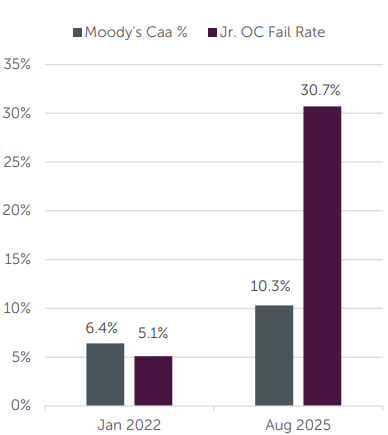
Figure 1: Credit Risk leading to structural failure: in post-RP structures, higher CCC Exposure Triggering Structural Breaches
A Portion of the Market Under Structural Pressure
CLO forced selling is mostly playing out beneath the surface. While growing, headline “hard” default rates remain within historical ranges. However, when LMEs are included, the default rate in middle market leveraged loans is approaching 8%, nearly the default rate experienced shortly after Lehman Brothers failed in 2009. While LMEs extend duration (often at the cost of higher debt and interest burdens), they typically trigger credit downgrades across the capital structure. Although bankruptcy may be avoided, at least in the medium term, LMEs still add pressure to CLOs through credit downgrades and their OC test metrics. Accordingly, within the CLO ecosystem, an increasing share of managers are approaching and entering a post-breach regime. These managers are no longer interested in owning yieldy loans; rather, they're sellers of risk, trying to repair their OC cushions and regain access to equity distributions. Lower returns on, or even impairment of, CLO equity not only affect the individual CLO in question but also the manager’s ability to raise subsequent CLOs. The more downgrades and LMEs occur, particularly in today’s environment where downgrades exceed upgrades, (as reviewed in Part 1 of this Insight Series) the more selling pressure is expected to intensify across CCCs and weak single-B names.
This structural unwind is a critical second-order effect in today’s credit markets — quieter than a headline-grabbing “stated default rate,” but no less impactful in shaping flows, security pricing inefficiency, and Axar’s investment opportunity set.
The secondary credit market often resembles a cartoon physics experiment: companies sprint past their fundamentals, only to look down and plunge when reality catches up. These overreactions create the very inefficiencies Axar is built to capture. We don’t rush in; we wait for gravity to do its work, then deploy capital with conviction at levels where risk and reward are most attractive.
III. Sponsor Activity: LMEs Create Clean Capital Structures and Fresh Opportunity
As noted in Part 1 of this Insight Series, the overall default rate has steadily increased since 2022, driven by deteriorating credit conditions as well as a sharp rise in Liability Management Exercises (LMEs). At Axar, we believe LMEs are creating a fresh and actionable investment opportunity set, offering both new-money capital solutions and liquid-market secondary-debt purchases.
As shown in Figure 2, the rate of LMEs reached a record high in 2024. While the pace of LME activity has moderated somewhat so far YTD, the structural forces behind the trend remain firmly in place: borrower-friendly credit documentation, elevated interest rates, and corporate boards increasingly willing to pursue aggressive liability management strategies. These dynamics have been most acute in the loan market, which (1) expanded rapidly between 2015 and 2021, (2) is definitionally sensitive to higher base rates, and (3) experienced significant erosion in creditor protections as it grew, all of which have made this segment particularly vulnerable to opportunistic maneuvers by Financial Sponsors.
Uptick in Distressed Exchanges, Led by Loans iii
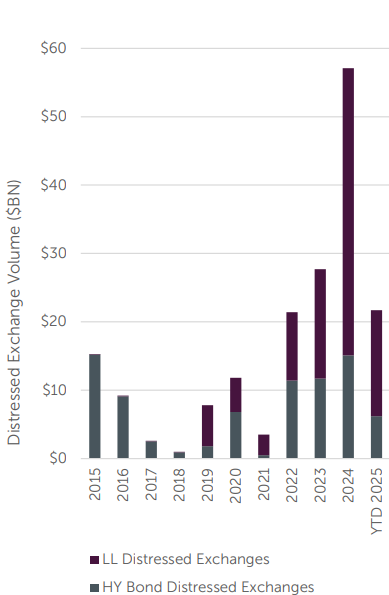
Figure 2: Recent uptick in distressed exchanges, led by loans.
From a borrower’s perspective, LME transactions offer a temporary lifeline: raise additional debt, usually super-senior, for fresh liquidity to “kick the can” and hope for a recovery in profitability that deleverages the capital structure. Although LMEs can realign a company’s capital structure without the expense and stigma of a formal bankruptcy, they often leave behind a complex, underfollowed credit that continues to burn cash, one that incumbent lenders, especially CLOs, are eager to exit. In nearly every LME we’ve studied, the fundamental issue of a “bad balance sheet” remains unresolved.
LMEs span a broad range of sponsor-led tactics including uptiers, drop-downs, double-dips, spin-offs, coercive exchanges, and maturity extensions. Many of the companies involved fit squarely within Axar’s investment focus.
Based on data from Octus, approximately 60% of recent LME activity falls within the sub-$1 billion debt outstanding segment, Axar’s sweet spot. Furthermore, Axar is actively tracking numerous pre-LME situations that we would be excited to invest in, depending on how negotiations evolve and what the post-transaction dynamics ultimately look like.
Notably, post-LME complexes generally trade at a discount to the overall market, reflecting dislocation and a demand/supply imbalance. For example, according to Moelis, recent super-priority financings have priced roughly 115 basis points wide of average single-B spreads. Additionally, based on our pipeline of investments, we typically see exchanged “2-out” risk trading in the 15–25% yield-to-maturity range, which imply equity returns for senior secured risk. While some of these securities may ultimately become the fulcrum in a future restructuring, the risk/reward skew can be highly attractive. This is particularly true when entered at a price discount, with tight terms and improved post-transaction clarity.
From our lens as opportunistic investors ready to underwrite a business with a fresh set of eyes, these post-LME securities typically feature improved documentation and discounted entry points as incumbent CLO holders seek to exit. As information asymmetry fades post-LME, we have also observed a meaningful improvement in trading liquidity, enabling new investors, including Axar, to underwrite go-forward business risk without the overhang of legacy credit agreements.
IV. Limited Competition: A Wider Moat
As described in detail of Part II of this Series, there has been a retreat of competitors in our space of middle market opportunistic credit investing. This has been driven by several factors, including: (i) the desire for strategy diversification, including into more scalable areas like direct lending or asset backed finance; (ii) the growth in size of the remaining distressed credit funds; (iii) potential conflicts with other lending strategies credit funds employ; (iv) strategy complexity. The confluence of these factors limiting demand for middle-market distressed debt often causes loans or bonds to transfer at prices well below fundamental value. This results in a “complexity premium” that is more pronounced in the middle market than in larger capital structures, driven by the scarcity of investors with the mandate, expertise, and patience to navigate such situations.
Axar’s Advantage
Our approach is built for this market. We go deep, not wide. We focus on a set of complex middle-market situations, not indiscriminate allocations to hundreds of companies. This leads us to our final piece, in which we will explore how Axar’s investment process, expertise, and mandate align with this opportunity set, and why we believe we are positioned to deliver strong, consistent, and uncorrelated returns in a market other investors increasingly overlook.
DISCLOSURE
Axar Capital Management LP (“Axar”) has prepared this presentation (“Presentation”) for informational purposes only. This Presentation is not intended to constitute legal or tax advice and is not an investment recommendation.
This Presentation does not constitute an offer to sell or a solicitation of an offer to purchase any investment or any securities in an Axar-managed vehicle (a “Fund”). Such an offer can only be made at the time a qualified offeree receives the relevant offering documents which contains important information (including investment objectives, policies, risk factors, fees, tax implications and relevant qualifications), and only in those jurisdictions as permitted by law. Investment in a Fund is speculative and involves risk of loss. There can be no assurance that a Fund will achieve their investment objective. Investing involves a material risk of loss. Past performance is not indicative of future results.
While all the information contained in this Presentation is believed to be accurate, no guarantee, representation or warranty is made as to the accuracy, completeness or fairness of the information contained in this Presentation. Certain information in this Presentation reflects the current opinions of Axar which may prove to be incorrect and are subject to change. Certain information contained in this Presentation constitutes “forward-looking statements,” which can be identified by the use of forward-looking terminology such as “may,” “will,” “should,” “expect,” “anticipate,” “target,” “project,” “estimate,” “intend,” “continue,” or “believe” or the negatives thereof or other variations thereon or comparable terminology. Due to various risks and uncertainties, actual events or results may differ materially from those reflected or contemplated in such forward-looking statements.
END NOTES / SOURCES
(i) $1.4tn market -> 75% owned by CLOs -> ~20% of that market is post-RP
(ii) BAML
(iii) JP Morgan, YTD 2025 data through August
Contact Us
Axar Capital Management LP
402 W 13th Street, 5th Floor New York, NY 10014
Email: investorrelations@axarcapital.com
Topics:



.png?width=1200&height=628&name=Untitled%20design%20(18).png)








.jpg?width=360&height=203&name=imgi_13_648847-img_bars%20(1).jpg)