---
title: The Compounders Built on Overlooked Balance Sheets
description: Berkshire, Danaher, and some of private equity's most respected firms built lasting value in the middle market by choice. Axar explains why similar underwriting principles apply to credit today.
image: https://insights.axarcapital.com/hubfs/70572-%20Axar-%20Blog%207_%20MiMM%20Feature%20Image.png
---
[Skip to main content](https://insights.axarcapital.com/compounders-built-on-overlooked-balance-sheets#maincontent)
- [Home](https://axarcapital.com/)
- [About](https://axarcapital.com/about)
- [Our Values](https://axarcapital.com/our-values)
- [Approach](https://axarcapital.com/approach)
- [Team](https://axarcapital.com/team)
- [Careers](https://axarcapital.com/careers)
- [News & Insights](https://insights.axarcapital.com/)
- [Contact](https://axarcapital.com/contact)
- [Login](https://access.hedgeserv.com/wauth/login)
[« View All Posts](https://insights.axarcapital.com)
# The Compounders Built on Overlooked Balance Sheets
August 5th, 2026
4 min read
By [Axar Capital Management LP](https://insights.axarcapital.com/author/axar-capital-management-lp)

The Compounders Built on Overlooked Balance Sheets
8:20
See's Candies. Nebraska Furniture Mart. Borsheim's. Berkshire Hathaway's formative deals were not famous companies. They were middle market businesses the broader market had failed to recognize, because their moats were not attached to household-name scale. Danaher, Markel, and Loews Corporation built multi-decade, multi-billion-dollar compounding machines on the same pattern. So did some of private equity's most respected long-run track records, built in the middle market by choice, not by default.
None of these firms stumbled into the middle market because they couldn't compete for larger deals. They went looking there on purpose, and the reasons they gave for it sound almost identical decades apart.
## Built By Buying What Most Ignored
Berkshire's first great purchases were never a secret. They were simply beneath the interest of the capital that mattered at the time. See's Candies had a regional following and a pricing power nobody outside California had bothered to price in. Nebraska Furniture Mart dominated a market few coastal investors could find on a map. Borsheim's did the same in jewelry.
****
## The Compounders Nobody Called Mega-Cap
Danaher, Markel, and Loews Corporation did not build their reputations on a single genius acquisition. They built them by repeating the same underwriting discipline for decades: find a niche leader the market has graded down for its size rather than its quality, and let the compounding do the rest. We look for the same signature. None of the three needed to be a mega-cap itself to build one. It needed to be right, patiently and repeatedly, about where the crowd wasn't looking.
## Why the Best Firms Chose Small on Purpose
Some of the most respected long-run track records in private equity, Hellman & Friedman, GTCR, Madison Dearborn, and Leonard Green among them, were built on middle market platforms. These firms did not fail to find mega-cap deals.
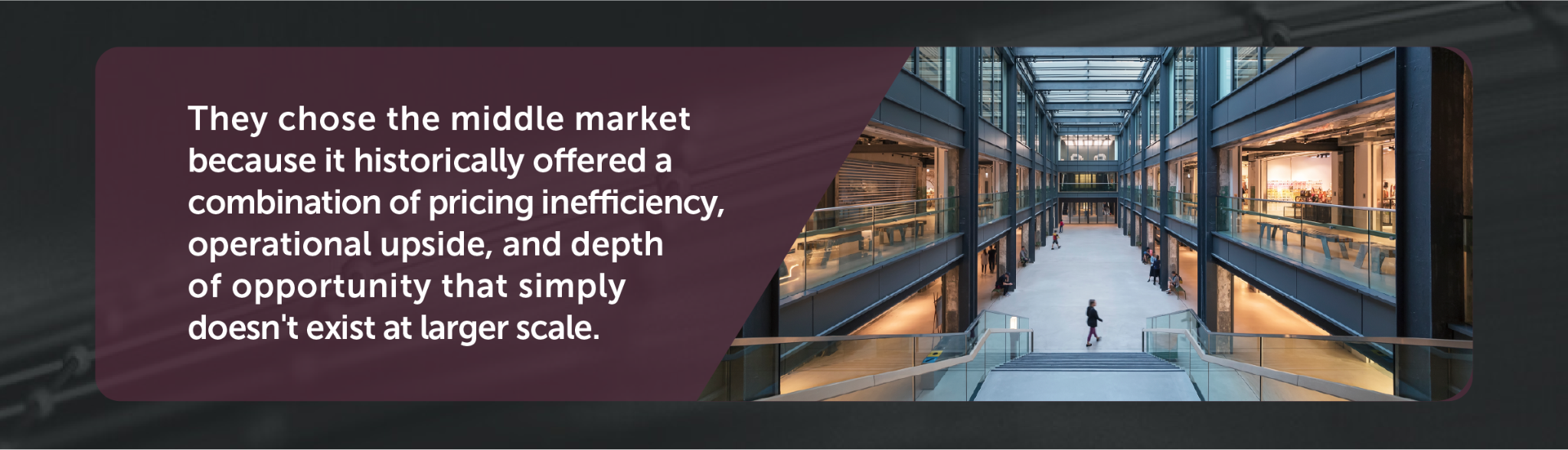
Scale was never the constraint. It was the thesis.
## The Pattern Repeats in Credit
The logic that built Berkshire and staffed a generation of respected private equity firms applies just as directly to credit. Structurally constrained holders, CLOs, mutual funds, ETFs, become forced sellers of exactly the kind of business these investors spent decades buying: a dominant niche leader nobody else wanted to own at the price it was trading. We look at the same pattern from a different rung of the capital structure, buying the debt of moated middle market businesses from weak hands, with a similar instinct that built compounding machines out of unglamorous companies for the better part of a century.
Envisioning the exit at entry isn't a new idea. It's simply being applied here to a different part of the capital structure than the one Buffett started with.
## What This Means for Underwriting
The lesson isn't "buy small companies." It's "price the moat, not the ticker size." A $400 million debt structure and a $40 billion market cap can carry the same kind of durable advantage, a regulatory license, a captive customer base, a cornered input, and the market will still price them differently for reasons that have nothing to do with either business's actual quality. That gap between price and quality is where every firm in this piece made its money, and it's the same gap we look for on the credit side of the same trade.
It's also why this pattern tends to persist rather than get arbitraged away. Recognizing it requires doing the underwriting work on a business too small or too complicated for most institutional capital to bother with, which is precisely the diligence cost that keeps the opportunity set open.
None of this required a contrarian temperament for its own sake. Buffett wasn't buying See's Candies to be different. He was buying it because the price and the business had stopped agreeing with each other, and he was willing to look somewhere the rest of the market had already stopped checking. We apply similar underwriting principles to a different rung of the capital structure. The gap doesn't close because nobody's looking. It closes because someone finally does the work.
#### [](https://insights.axarcapital.com/hs/cta/wi/redirect?encryptedPayload=AVxigLIBvh7itVNpo6sWvCWdcRDdNsg3YvlVAAPkevApsMO0HAfUJqvwX3jX9WQGOD8m7yQ9U259F6E3jgS8mgDeNgm%2FeuKgw0bUOu33WlcmWqAit11QSBpslJ2ZonTu8zv727LgJQVApbDAwWU3vYjodk6bbSRuIGS6ELFuUK0ORsqRivYc0S2bBohQaPd48SxPBqlfjCfxJIygl5TOHI%2Bq8goaXHq3%2F%2BKgeNZBZ7KBysM%3D&webInteractiveContentId=215196773816&portalId=49721052)
This material is provided for informational purposes only and does not constitute an offer to sell or a solicitation of an offer to buy any securities or investment advisory services. The views expressed herein are those of Axar Capital as of the date of publication and are subject to change without notice.
This material is not intended to provide, and should not be relied upon for, investment, legal, or tax advice. Any forward-looking statements or discussions of potential outcomes are based on current expectations and assumptions and are subject to change. There can be no assurance that any investment strategy will be successful or that any outcomes discussed herein will be achieved. References to specific investments are provided for illustrative purposes only and do not represent all investments made by Axar Capital. Past performance is not indicative of future results.
### FAQ Section
If this pricing gap is real, why hasn't more institutional capital already arbitraged it away?
In our view, the answer is diligence cost, not lack of awareness. Underwriting a business too small or complex for most institutional capital to bother with is precisely what keeps the inefficiency open. The gap doesn't close because nobody sees it. It closes only when someone actually does the work.
How do you verify a business has a durable moat before committing capital, rather than inferring it from market position alone?
Market share is a starting point, not a conclusion. We look for the structural reason a position is defensible, a regulatory license, a cost advantage, a switching cost, and test whether that reason would survive a change in management, ownership, or balance sheet, not just whether the company currently leads its category.
Does this framework apply equally across industries, or is niche dominance a more reliable signal in some sectors than others?
It varies. A regulatory moat behaves differently under distress than a scale-driven one, and we underwrite them differently as a result. The size of the niche matters less than the specific mechanism protecting it.
Does identifying this kind of mispricing change how a position gets sized or priced at entry?
Yes. A business with an intact moat obscured by capital structure justifies a different entry price and structure than one that is simply distressed and cheap. The distinction changes the underwriting, not just the thesis.
Is this approach specific to Axar, or could other credit investors replicate it?
The logic itself isn't proprietary; Buffett described a version of it decades ago. What's harder to replicate is the willingness to do the diligence work on businesses this size, which is the actual constraint, not the insight.
#### About Axar Capital Management
Axar Capital Management LP is a $3.3 billion opportunistic investment manager focused on U.S. middle market companies with $200 million to $800 million in debt outstanding. Founded in 2015 and 100% employee-owned, Axar specializes in complex situations where traditional institutional capital operates inefficiently. The firm is headquartered at 402 W 13th Street, New York, NY.
**Disclaimer:** Axar Capital Management LP ("Axar") has prepared this content for informational purposes only. This content is not intended to constitute legal, tax, financial, or investment advice. While all information contained herein is believed to be accurate, no guarantee, representation or warranty is made as to its accuracy, completeness or fairness. Certain information reflects the current opinions of Axar which may prove to be incorrect and are subject to change. Past performance is not indicative of future results. Investing involves a material risk of loss. Certain statements herein reflect forward-looking views, which are inherently uncertain and subject to change. Actual results may differ materially.
Topics:
[Insights](https://insights.axarcapital.com/topic/insights)
Don't forget to share this post:
## Related Articles
### [.png?width=2400&height=1257&name=73618-%20Axar-%20Blog%20%2310%20-%20derived%20from%20The%20Chopping%20Block%20-%20Feature%20Image%20(1).png) The Nucleus: Why a Failed Balance Sheet Doesn’t Mean a Failed Business September 24th, 2026|4 min read](https://insights.axarcapital.com/the-nucleus-why-a-failed-balance-sheet-doesnt-mean-a-failed-business)
### [ The AI Value Gap August 21st, 2026|4 min read](https://insights.axarcapital.com/the-ai-value-gap)
### [ Switching Costs, The Moat Customers Don't Notice They're Trapped By August 19th, 2026|4 min read](https://insights.axarcapital.com/switching-costs-the-moat-customers-dont-notice)
### [.png?width=1200&height=628&name=Untitled%20design%20(18).png) 2026 2H Market Outlook – the “Velvet Rope Market” July 9th, 2026|4 min read](https://insights.axarcapital.com/2026-2h-market-outlook-velvet-rope-market)
### [ Active vs. Passive in Distressed Credit: Why Showing Up at the Table Changes the Outcome June 18th, 2026|4 min read](https://insights.axarcapital.com/active-vs-passive-distressed-credit)
### [ The PE Overhang: Why Sponsors Are Stuck and What It Means for Credit June 3rd, 2026|4 min read](https://insights.axarcapital.com/private-equity-overhang-dpi-credit-markets)
### [ What Happens to a Company After a Liability Management Exercise May 20th, 2026|4 min read](https://insights.axarcapital.com/what-happens-after-liability-management-exercise)
### [ CLOs Own 75% of the Leveraged Loan Market. Here's Why That Creates Pricing Anomalies. May 6th, 2026|4 min read](https://insights.axarcapital.com/clo-overcollateralization-leveraged-loan-pricing-anomalies)
### [ The Chopping Block: The Anatomy of a Great Distressed Investment April 24th, 2026|4 min read](https://insights.axarcapital.com/the-chopping-block-the-anatomy-of-a-great-distressed-investment)
### [ The Lenders Who Left: How a Decade of Easy Money Quietly Reshaped the Distressed Credit Landscape April 22nd, 2026|4 min read](https://insights.axarcapital.com/the-lenders-who-left-distressed-credit-landscape)
### [ Credit Quality in Decline — Why the Middle Market Is Axar's Hunting Ground April 10th, 2026|4 min read](https://insights.axarcapital.com/credit-quality-in-decline)
### [ From Grave Concerns to Growth: The Everstory Revival March 30th, 2026|4 min read](https://insights.axarcapital.com/from-grave-concerns-to-growth-the-everstory-revival)
### [.jpg?width=360&height=203&name=imgi_13_648847-img_bars%20(1).jpg) 2026 Market Outlook January 19th, 2026|4 min read](https://insights.axarcapital.com/2026-market-outlook)
### [ The Chopping Block: Building Culture- How Two CEOs Turned Distress into Durable Growth November 11th, 2025|4 min read](https://insights.axarcapital.com/the-chopping-block-building-culture-how-two-ceos-turned-distress-into-durable-growth)
### [ Credit Unbound IV: Capitalizing on a Shifting Opportunity Set October 27th, 2025|4 min read](https://insights.axarcapital.com/credit-unbound-part-4)
### [ Credit Unbound III: Capitalizing on a Shifting Opportunity Set September 15th, 2025|4 min read](https://insights.axarcapital.com/credit-unbound-part-3)
### [ Credit Unbound II: Capitalizing on a Shifting Opportunity Set September 8th, 2025|4 min read](https://insights.axarcapital.com/credit-unbound-part-2)
### [ Credit Unbound I: Capitalizing on a Shifting Opportunity Set September 1st, 2025|4 min read](https://insights.axarcapital.com/credit-unbound-part-1)
### [ The Chopping Block: Chipping Away at the LME Opportunity June 20th, 2025|4 min read](https://insights.axarcapital.com/the-chopping-block)
### [ When The Music Stops March 3rd, 2025|4 min read](https://insights.axarcapital.com/when-the-music-stops)
### [ Cashing In On Cash Now October 15th, 2024|4 min read](https://insights.axarcapital.com/cashing-in-on-cash-now)
### [ Jailbreaking Value July 1st, 2024|4 min read](https://insights.axarcapital.com/jailbreaking-value)
- [Home](https://axarcapital.com/)
- [About](https://axarcapital.com/about)
- [Our Values](https://axarcapital.com/our-values)
- [Approach](https://axarcapital.com/approach)
- [Team](https://axarcapital.com/team)
- [Careers](https://axarcapital.com/careers)
- [News & Insights](https://insights.axarcapital.com/)
- [Contact](https://axarcapital.com/contact)
- [Login](https://access.hedgeserv.com/wauth/login)
© 2026 Axar Capital Management LP. All Rights Reserved.
Privacy Policy. Terms Of Service.
```json
{
"@context" : "https://schema.org",
"@type" : "BlogPosting",
"author" : {
"@type" : "Person",
"name" : "Axar Capital Management LP",
"url" : "https://insights.axarcapital.com/author/axar-capital-management-lp"
},
"dateModified" : "2026-08-05T19:51:24.761Z",
"datePublished" : "2026-08-05T19:51:24.000Z",
"headline" : "The Compounders Built on Overlooked Balance Sheets",
"image" : [ "https://insights.axarcapital.com/hubfs/70572-%20Axar-%20Blog%207_%20MiMM%20Feature%20Image.png" ],
"mainEntityOfPage" : {
"@id" : "https://insights.axarcapital.com/compounders-built-on-overlooked-balance-sheets",
"@type" : "WebPage"
},
"publisher" : {
"@type" : "Organization",
"logo" : {
"@type" : "ImageObject",
"url" : "https://insights.axarcapital.com/hubfs/Logo/Axar_logo.png"
}
}
}
```