
“I have a structured settlement, but I need cash now! Call J.G. Wentworth, 877- CASH-NOW. I have an annuity, but I need cash now! Call J.G. Wentworth, 877- CASH-NOW, 877-CASH-NOW. They’ve helped thousands, they’ll help you too. One lump sum of cash, they will pay to you. If you get long-term payments, but you need cash now. Call J.G. Wentworth, 877-CASH-NOW, 877-CASH-NOW, 877- CASH-NOW. It’s your money, use it when you need it.”
In November 2013, the outlook for J.G. Wentworth (“JGW”) seemed promising as the company completed its initial public offering (IPO) on the NYSE raising $150 million of equity capital and quickly reaching an enterprise value above $800 million. However, as the company entered 2014, the seeds of the future distress were being planted and senior management began to exit the business, culminating with the resignation of long-time CEO, David Miller, in July 2014. All of Miller’s top executives, including 25-year company veteran and President, Randi Sellari, were gone by the end of that year.
The core structured settlement business began to come under some financial pressure in late 2014 due to increased competition from a series of new entrants (all of whom eventually failed). The combination of high leverage (over $450mm of debt outstanding from a recently completed dividend recap / 5x+ EBITDA) coupled with a new management team lacking experience in structured settlements became a deadly mix for the newly public company.
Without the benefit of the prior management team’s experience, the new management team managed operating costs at the expense of future revenue by aggressively cutting the sales team and marketing expenditures in the structured settlement business. This was the opposite approach that the company historically used to defend market share. This new management team then used all available capital to attempt to diversify into consumer mortgages and credit cards, both areas where the individuals had prior experience.
In late 2017, four years after the IPO, J.G. Wentworth filed for Chapter 11 bankruptcy protection. During this short and tumultuous period, consolidated EBITDA declined from $110mm in 2014 to just $20mm in 2017.
COMPANY BACKGROUND
The J.G. Wentworth Company was founded in 1991 and for nearly 30 years specialized in purchasing structured settlements, annuities, and lottery payments in exchange for a lump-sum cash settlement. The company has been the market leader in this niche consumer financial services segment and is known for its powerful direct-to-consumer cable TV marketing (“877-CASH-NOW”). The company has spent over $1 billion on advertising since inception and has over 80% national brand awareness; the jingle (“I have a structured settlement and need cash now”) is ubiquitous in American culture and was most recently featured on the hit TV show Curb Your Enthusiasm (it was not a paid product placement; the show producers reached out to JGW for permission to use the brand and jingle).
Beginning in the late 1990s, the company was owned by several private equity investors including JLL Partners, the owner prior to Axar. Over a decade of ownership, JLL achieved significant success with JGW including the acquisition of Peachtree (the number two player), completing several dividend recapitalizations and the 2013 IPO.
AXAR IDENTIFIES AN OPPORTUNITY
JGW first came to Axar’s attention via its regular weekly screening process. By late 2015, JGW’s $450mm term loan (used to fund JLL dividends prior to the IPO) was trading below 60% of par as the company’s financial performance had significantly deteriorated.
Axar immediately recognized the well-known brand and a balance-sheet-heavy financial services business, which is a core competency for the team.
As a specialty finance company that regularly finances the structured settlement annuities it purchases, JGW has a complex balance sheet comprised with GAAP line items that can be very confusing to the uninitiated: warehouse lines, residual tranches, mortgage servicing rights, interest rate hedges, variables interest entities, reserve cash, non-recourse financing, etc. One quick glance showed significant negative GAAP book value and liabilities greater than assets. However, upon digging a bit deeper into the 200+ page 10-K, the true financial picture (and opportunity) became clear and exciting to Axar. In the cryptic Notes section, there were hidden gems: ~$75mm of unencumbered structured settlement assets on balance sheet, $50mm of ABS residual tranches, $90mm of unencumbered cash and a $75mm unencumbered mortgage servicing right asset. In total, Axar calculated over $300mm of tangible, liquid available asset value (secured by the $450mm term loan by then trading at 40% of par) and before ascribing any value to the brand or 30-year+ operating history of strong cashflow generation.
Axar started to accumulate a position in the term loan around 40% of par, effectively buying ~$300mm of assets for just $140mm with the brand and business thrown in for free. Axar ultimately purchased ~30% of the term loan and helped lead the negotiations for a prepackaged Chapter 11 bankruptcy.
While actively purchasing the term loan, Axar proactively contacted David Miller, the former CEO, and recruited him to rejoin the board after bankruptcy as Chairman. During and shortly after the bankruptcy, Axar analyzed internal company data and could see mistakes the post-IPO management team had made. For example, there were instances where they failed to adjust their pricing model for duration, causing them to underprice the true fair market value for long-duration structured settlement assets. In what was essentially a “back to the future” playbook, Miller and Axar moved quickly and by April 2018 (just three months after exiting bankruptcy) replaced the CEO and management team with the pre-IPO group from Miller’s prior tenure; in total 10 individuals returned to the Company including the entire executive team (CEO, CFO, COO, GC, head of marketing, etc.).
BUYING FROM WEAK HANDS WHILE THE RECOVERY HAD ALREADY TAKEN HOLD
During 1Q18, still under the helm of the post-IPO management team, JGW reported $1.8mm of EBITDA. In 2Q18, now under the leadership of the pre-IPO team, JGW reported $7.2mm of EBITDA. By 2020, JGW’s structured settlement segment EBITDA had eclipsed the previous peak EBITDA achieved in 2012 just before the IPO. While the operating performance improved, Axar started to methodically sell those non-core assets identified in the original underwriting/diligence process to reduce its cost basis. Within the first 24 months, via the sale of non-core assets, Axar reduced its cost basis by ~50% while simultaneously consolidating its ownership by purchasing equity from other legacy term loan holders.
The former term loan holders were not natural equity owners, they wanted little involvement with the company’s new board or strategy. Despite continued strong performance in the overall business and forthcoming asset sales, the remaining term lenders were eager to liquidate their remaining positions when an Axar bid emerged. This selling is not uncommon; private credit and CLO funds are often penalized for holding equity, receive no management fees on those assets and lack the resources to adequately manage what often becomes an active, post-reorg equity investment. A common playbook, which Axar has seen countless times over the firm’s 9 years, is to hold the investment up to the last minute when debt converts to equity to maximize fees before selling quickly thereafter.
At times, Axar was purchasing equity at approximately 2x current year projected EBITDA. As the sellers were largely uninterested in price, value or company strategy, Axar was able to significantly increase its position, from ~30% to over 90% ownership, all while the investment significantly de-risked given the asset sales and operating performance.
Axar invested the most capital (via buying out other holders) into JGW in this post-reorg period where certainty of Chapter 11 outcome, management and financial performance were all on a steep upswing—a premeditated feature of Axar’s investment strategy.
As financial results continued to improve Axar worked with Miller to develop business strategy over the next several years. Given the power and awareness of the brand plus the strong levels of profitability, diversification of the business through the introduction of a new business line was a logical move for JGW. Remarkably, JGW monetized just 2% of all customer engagements; many customers wanted CASH NOW but JGW was limited by its niche market focus. A large and growing total addressable market with a customer demographic that would align with the existing marketing strategy were the top criteria.
A DISTRESSED OPPORTUNITY BECOMES A GROWTH OPPORTUNITY
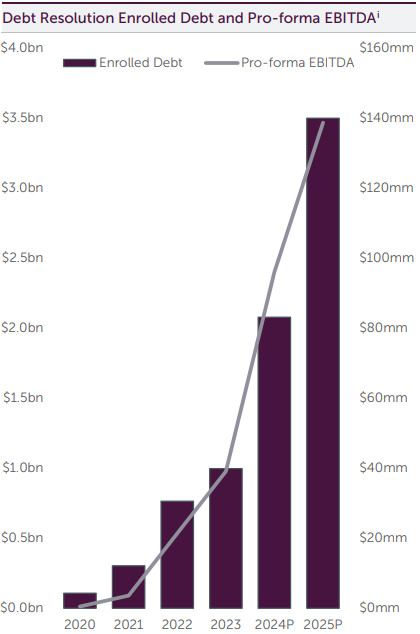
In November 2019, JGW entered the debt resolution business, which seeks to help consumers with too much credit card debt negotiate with their creditors to avoid personal bankruptcy. Axar calculates the total addressable market of the debt resolution business to be ~$75bn by 2027 compared to just $15bn of annual enrollments when JGW entered in 2019 and competitors were growing at over 100% annually. The business model leveraged many of JGW strengths: direct-to-consumer marketing competency, synergies with existing marketing campaigns, a multi-step, highly regulated consumer-focused call center operation, etc. Since 2019, JGW ramped up the debt resolution business to over $2.8bn of annual debt enrollediii and become the number five player in the space behind four companies who have each participated in the industry for at least 15 years. Axar expects continued rapid growth in enrolled debt and a significant contribution to overall profitability. In fact, despite the strong turnaround in the structured settlements business since 2018, Axar projects the growing debt resolution segment to generate more EBITDA for JGW than structured settlements in 2025.
LOOKING TO THE FUTURE…ABOUT TO CLOSE ANOTHER CHAPTER
The JGW investment embodies several key aspects of the Axar investment strategy: it identifies complex investment opportunities, creates an investment with tangible downside protection, manages process, demonstrates board and governance expertise, recruits and retains talented leadership (with particular focus on the CEO), leverages market structure (for example, CLO funds' aversion to equity) to generate derisked buying opportunities from weaker hands, and pinpoints areas for reinvestment and growth.
Adjusted EBITDAiv is poised to grow from ~$20mm in 2018 to over $240mm by 2026. The investment has now entered its final phase and Axar is focusing on the exit strategy. Axar has spoken with several leading global investment banks and had “fireside chats” with selected potential acquirers. Axar will work with management and its bankers to best position the business for a successful exit. Given the significant growth in profitability over the past several years and expectations for continued future growth, Axar and its bankers are confident of an exit multiple in the high single-digit or low double-digit range. With a significant portion of the cost-basis already returned, the JGW investment is poised to provide Axar’s investment partners with a strong return at exit.
The core elements of the JGW investment are ultimately a function of investment process, underwriting, unique positioning in the marketplace and the Axar strategy. The optionality that has become reality in JGW is a function of the downside protection created at Axar’s entry, the ability to execute on a defined strategy and patience (both in acquiring securities / deploying capital and executing a well-conceived turnaround plan). The investment process and philosophy embodies Axar’s investment approach that has been replicated multiple times over the past 9 years.
DISCLOSURE
Axar Capital Management LP (“Axar”) has prepared this confidential presentation (“presentation”) for informational purposes only.
The case study included in this presentation was selected based on objective, non-performance based criteria, namely that such portfolio company, in Axar’s opinion, is illustrative of Axar’s investment philosophy. The company identified does not represent all of the securities purchased, sold, or recommended by Axar.
Certain information contained in this presentation constitutes “forward-looking statements,” which can be identified by the use of forward-looking terminology such as “may,” “will,” “should,” “expect,” “anticipate,” “target,” “project,” “estimate,” “intend,” “continue,” or “believe” or the negatives thereof or other variations thereon or comparable terminology. Due to various risks and uncertainties, actual events or results may differ materially from those reflected or contemplated in such forward-looking statements. There is no guarantee Axar will be successful in achieving its objectives. Past performance is not indicative of future results.
While all the information contained in this presentation is believed to be accurate, no guarantee, representation or warranty is made as to the accuracy, completeness or fairness of the information contained in this document. Projected financial information and other forward-looking statements do not, nor are they intended to, constitute a promise of actual results. Such information and forward-looking statements involve known and unknown risks, uncertainties and other important factors that could cause actual results, performance, achievements or industry results to differ materially from the financial information, projections and estimates included in this presentation.
Certain information contained in this presentation is non-public, proprietary, and highly confidential and is provided to selected recipients only on a confidential basis. Accordingly, by accepting this presentation, the recipient acknowledges and agrees that it will maintain the information and data contained herein in the strictest of confidence and will not reproduce this presentation or disclose any of the contents hereof to any other person unless permitted by Axar.
This document is not intended to constitute legal or tax advice and is not an investment recommendation.
End Notes
i Source J.G. Wentworth
ii Source: J.G. Wentworth
iii 2024 forecast.
iv Adjusted EBITDA includes management adjustments for certain non-recurring or non-GAAP items. 2026 projection is provided by J.G. Wentworth.
Topics:



.png?width=1200&height=628&name=Untitled%20design%20(18).png)








.jpg?width=360&height=203&name=imgi_13_648847-img_bars%20(1).jpg)